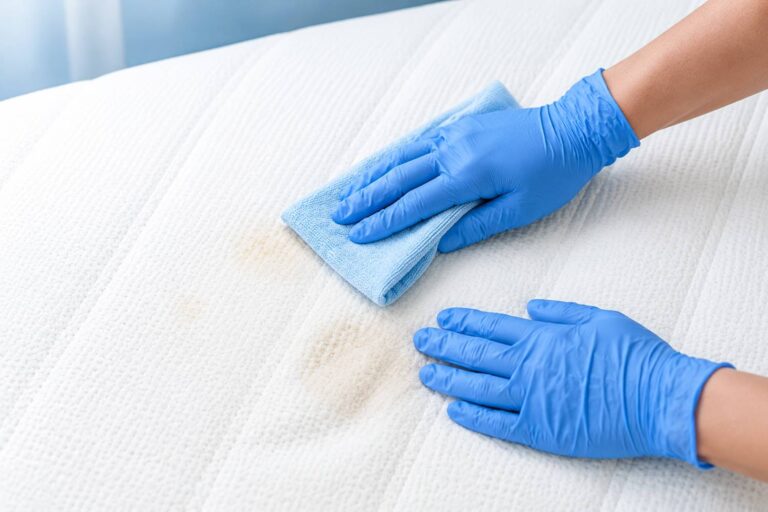
Finding mould on your carpet, or noticing a musty smell that won’t go away, is unsettling, especially if you’re not sure whether the carpet can be saved or needs to go. Here’s the honest answer:
professional carpet cleaning may help when contamination is limited, recent and confined to the carpet pile after the moisture source has been corrected. It cannot reliably solve mould that has penetrated the backing, underlay or subfloor, covers a substantial area, keeps returning or follows contaminated flooding. In those cases, specialist remediation and partial or full replacement may be safer.
The real question isn’t just what’s visible on the surface, it’s whether moisture and contamination have reached the backing, underlay or subfloor beneath it. This guide walks through how to tell the difference, what a proper assessment checks, and when cleaning is the right call versus when it isn’t. An assessment before any treatment can prevent both unnecessary replacement and inappropriate cleaning.
Found mould or a persistent musty smell? Send us clear photosvia WhatsApp and tell us what caused the moisture, how large the area is and how long it has been damp. We’ll advise whether a carpet-cleaning assessment is appropriate.
Does Professional Carpet Cleaning Remove Mould?
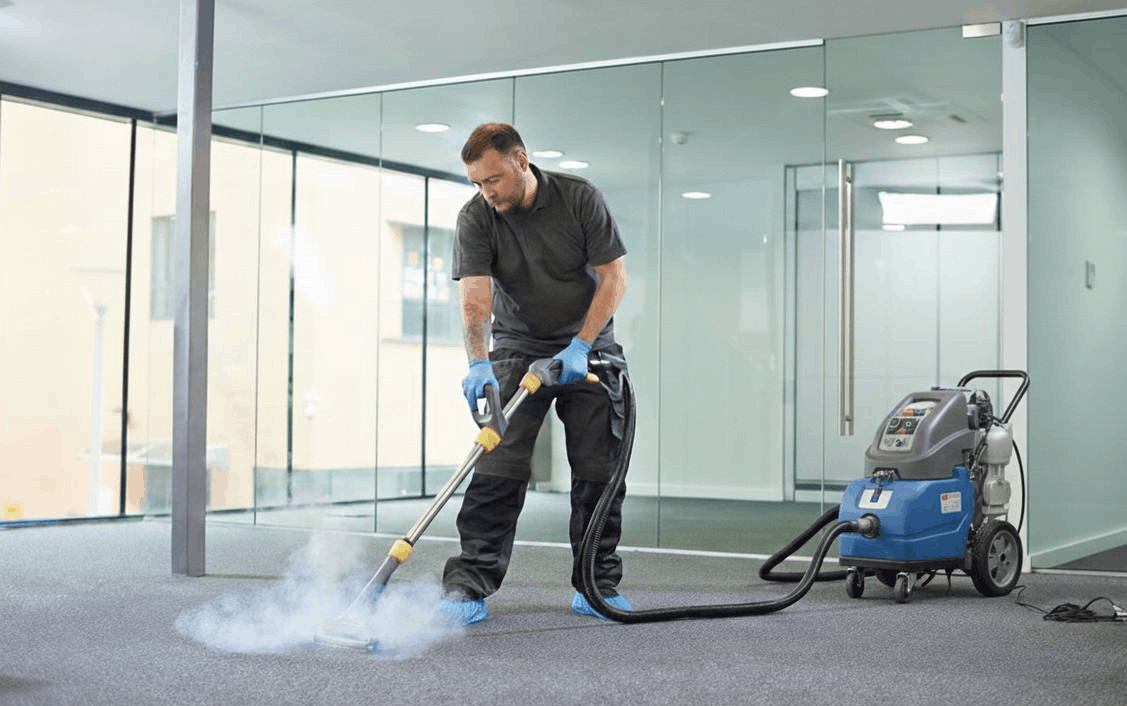
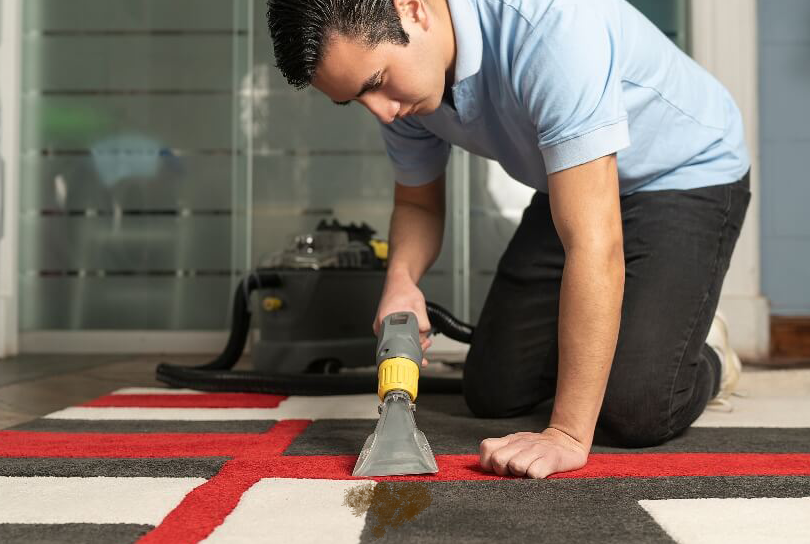
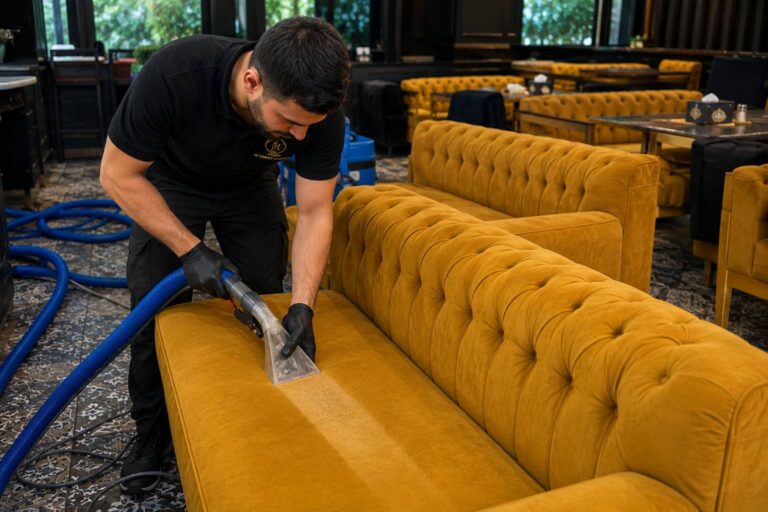
The answer has two parts. Professional cleaning, typically hot-water extraction, can reduce or remove limited contamination and settled spores from carpet fibres that are otherwise sound and cleanable. It is not, however, a universal remedy for active or deep-seated growth. Extraction pulls soil, moisture and settled contamination out of the pile, and rapid, thorough drying afterwards limits the conditions mould needs to re-establish itself. But cleaning works on the carpet you can see and reach, it can’t compensate for an active leak, ongoing condensation, or a subfloor that’s still damp underneath.
In brief:
- Cleaning may be considered when the patch is small, recent, surface-level, and the carpet and underlay can be fully dried.
- Replacement or specialist remediation is more likely when growth is widespread, recurrent, deep, flood-related, or the underlay/subfloor is affected.
How to Tell Whether the Problem Is Surface-Level or Deeper
Signs the carpet may be salvageable
- The affected area is small and localised.
- The incident involved recent, clean water.
- There’s no persistent dampness once the source has been fixed.
- There’s no strong odour coming from the underlay or floor beneath.
- The backing and underlay don’t show visible staining or growth.
- The material can be safely cleaned and dried quickly.
Signs cleaning alone may not be enough
- Mould covers a large area or appears in multiple locations.
- The patch has returned after a previous clean.
- The backing, underlay, grippers or subfloor are affected.
- The carpet stayed wet for an extended period.
- The moisture source was sewage, drain water, or otherwise contaminated.
- There’s deterioration, delamination, permanent staining or a severe, persistent odour.
- Occupants are particularly vulnerable to airborne irritants, or are experiencing symptoms.
- The moisture source itself hasn’t been resolved yet.
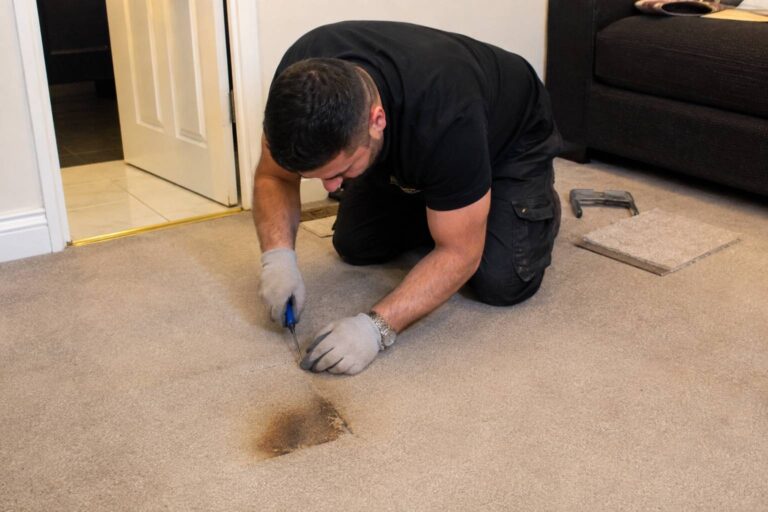
These are triage indicators, not a remote diagnosis. A photograph can help with initial advice, but lifting an edge of the carpet, a moisture assessment, or a specialist inspection may be needed to know for certain what’s happening underneath.
A musty smell is usually the first warning sign, see how to get a musty smell out of your carpet before it worsens.
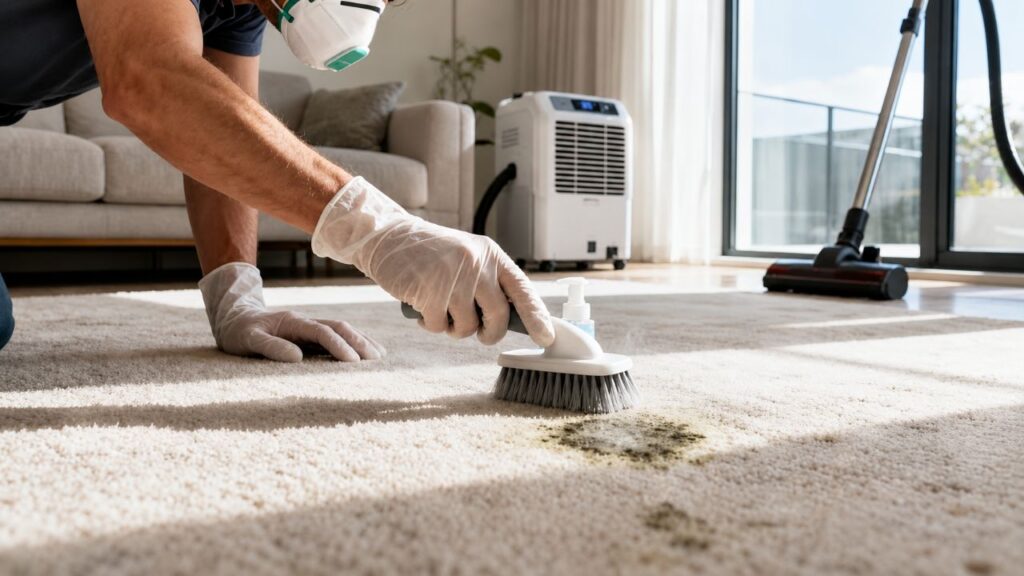
Cleaning or Replacement? Use This Decision Table
Situation | Is professional cleaning potentially appropriate? | Is remediation or replacement more likely? | Reason / next step |
Small, recent surface patch after a clean-water spill | Possibly — inspection first | Unlikely, if caught early | Usually confined to the pile if dried promptly |
Musty smell but no visible mould | Possibly — inspection first | Possibly | Odour without visible growth still needs a moisture check under the carpet |
Growth confined to a removable carpet tile | Possibly — inspection first | Sometimes simpler to replace the tile | Compare cost and risk of cleaning vs swapping the affected tile |
Mould visible on the backing | Unlikely | Usually — subject to site assessment | Backing contamination often signals underlay involvement |
Underlay feels damp or smells strongly | Unlikely | Usually — subject to site assessment | Underlay is porous and hard to fully dry or clean in place |
Large or recurring affected area | Unlikely | Usually — subject to site assessment | Recurrence suggests an unresolved moisture source |
Exposed to sewage or contaminated floodwater | No | Yes | Contaminated water is a health and hygiene escalation trigger |
Leak repaired but carpet remained wet for days | Possibly — inspection first | Possibly | Extended wet dwell time increases risk of deeper contamination |
High-value or unusual carpet where replacement is difficult | Possibly — inspection first | Only if assessment confirms deep contamination | Worth a thorough assessment before ruling cleaning out |
Not sure whether the carpet can be saved? Request an assessment via WhatsApp before paying for routine cleaning or replacing the carpet unnecessarily.
What a Professional Assessment Should Check
Before agreeing to clean (or recommending replacement), a proper assessment looks at:
- Whether the moisture source has been identified and resolved.
- The size and distribution of any visible growth.
- The carpet’s fibre type, construction and overall condition.
- The backing, underlay, grippers and any accessible subfloor.
- The type and duration of water exposure.
- Where any odour is coming from, and how persistent it is.
- Whether the carpet can realistically be extracted and dried promptly.
- Whether another trade, a plumber, damp specialist or remediation contractor — needs to be involved first.
Mould rarely travels alone, check whether cleaning also removes dust mites and allergens.
What Professional Carpet Cleaning Can and Cannot Do
What it may do
- Remove embedded soil and some settled contamination from the pile.
- Treat related staining and odour where the cause is appropriate for cleaning.
- Extract moisture more effectively than most domestic machines.
- Support faster drying when the right equipment and airflow are used.
What it cannot promise
- It cannot repair an unresolved leak or damp problem.
- It cannot confirm hidden layers are unaffected without an inspection.
- It cannot guarantee removal of every spore in the room or building.
- It cannot substitute for specialist remediation where growth extends beyond the carpet itself.
- It cannot guarantee mould won’t return if the moisture that caused it returns.
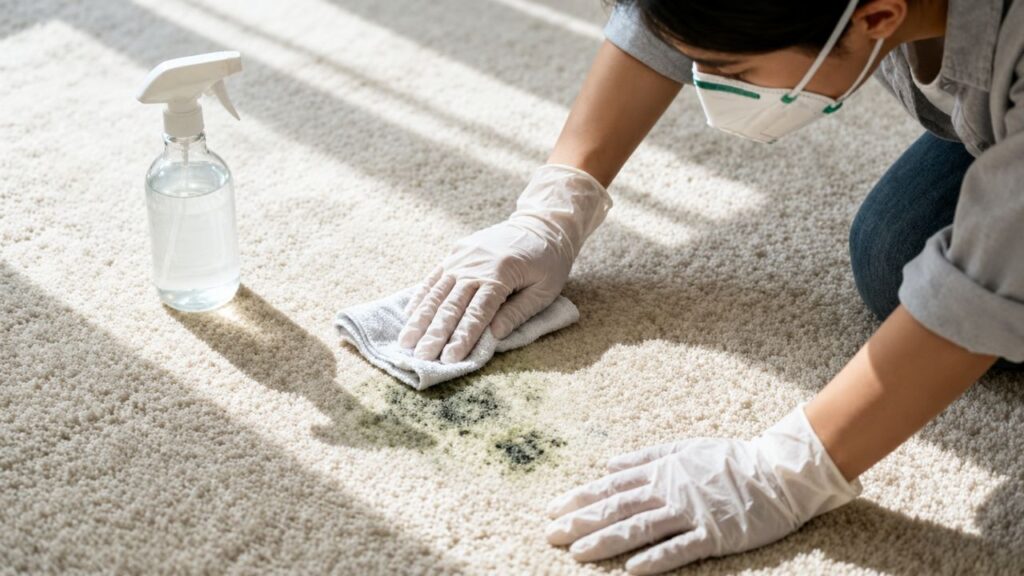
For contamination that’s spread through the pile, book our deep cleaning and stain treatment service.
Why Drying Time Matters
Carpet that stays wet for too long after cleaning, or after the original water event, is at higher risk of developing exactly the problem you’re trying to avoid. Drying time varies with fibre type, cleaning method and room conditions (our carpet drying time guide covers this in more detail).
Practically: follow your technician’s guidance on ventilation and access, hold off putting furniture back until the carpet is properly dry, and flag any persistent dampness or odour rather than waiting to see if it resolves on its own. No single drying time can be promised as a guarantee, conditions in each home differ.
What Not to Do When You Find Mould on Carpet
- Don’t scrub or dry-brush visible growth.
- Don’t run an ordinary vacuum directly over it.
- Don’t soak the carpet with DIY solutions.
- Don’t mix household chemicals.
- Don’t cover the area with furniture or a rug.
- Don’t book a routine clean without mentioning the mould, the water source and the affected size.
- Don’t assume a stain disappearing means the underlying cause is solved.
Disturbing visible growth, by scrubbing, brushing or vacuuming, risks dispersing particles into the air rather than removing the problem.
When to Contact a Mould Remediation or Building Specialist
A carpet cleaner and a remediation contractor solve different problems. It’s time to bring in a specialist, or a building/damp professional, when the affected area is extensive, when material beneath the carpet is involved, when the underlying source is structural (rising damp, a persistent leak, poor ventilation), when contaminated water was involved, or when the problem keeps coming back despite previous treatment.
If you’re renting, document what you’ve found, photos, dates, and any communication about the cause, and notify your landlord or managing agent promptly. GOV.UK guidance on damp and mould sets out how seriousness and duration affect health risk, which is useful context when raising the issue, though for anything involving legal deadlines or tenancy obligations, it’s worth checking current guidance or seeking advice specific to your situation.
Before arranging a visit, review current carpet cleaning prices in London and the factors that can affect the final quote.
Can Mould Be Prevented After Carpet Cleaning?
- Choose a cleaner who assesses fibre type and moisture risk before starting.
- Avoid overwetting, and make sure extraction is thorough.
- Maintain airflow and follow the drying instructions you’re given.
- Repair leaks and address condensation sources.
- Keep wet items, umbrellas, wet shoes, damp towels, off the carpet.
- Act quickly after spills or water intrusion rather than leaving carpet to dry slowly on its own.
- Investigate a recurring musty smell rather than masking it.
Regular professional carpet cleaning is the best way to prevent mould taking hold in the first place.
Final Verdict
There’s no single answer that applies to every mouldy carpet. Limited, surface-level contamination may well be cleanable, but only once the moisture source is fixed and the carpet and underlay can be dried properly. Mould that’s deep, widespread, recurrent, or the result of contaminated water is a different situation, and usually points towards specialist remediation or replacement rather than a standard clean.
The safest starting point is an assessment rather than a guess. For professional carpet cleaning in London, contact us via WhatsApp for an honest assessment and tailored quote. If your carpet needs leak repair, specialist remediation or replacement rather than cleaning, that should be identified before any treatment begins.

Frequently Asked Questions
Does professional carpet cleaning kill mould?
Hot-water extraction removes soil and settled contamination from cleanable carpet fibres and supports faster drying, but it shouldn’t be described as “killing” mould outright. Its value lies in removing what’s reachable and reducing the conditions mould needs, not in a guaranteed kill claim.
Can mouldy carpet be saved?
Sometimes. If contamination is limited to the pile, the incident was recent, and the carpet and underlay can be dried quickly and fully, cleaning may be appropriate. If the backing, underlay or subfloor are affected, or the area is large, saving the existing carpet becomes less likely.
When should mouldy carpet be replaced?
Replacement becomes more likely when growth is widespread or recurring, when it involves the backing, underlay or grippers, when the carpet was exposed to contaminated water, or when it stayed wet for an extended period. An assessment is the best way to confirm this rather than guessing from appearance.
How can I tell if mould is in the underlay?
A strong, persistent musty smell, especially one that doesn’t fade after airing the room, can indicate contamination beneath the surface. Dampness that lingers after the moisture source is fixed is another sign. Confirming this usually needs lifting an edge of the carpet or a professional inspection.
Does a musty smell mean there is mould under the carpet?
Not necessarily, but it’s a reason to check. A musty smell without visible growth can still indicate moisture or early contamination beneath the surface, so it’s worth having assessed rather than ignored.
How quickly must carpet dry after professional cleaning?
This varies with fibre type, method used and room conditions, so no single figure can be promised as a guarantee. Following your technician’s guidance on ventilation and access, and reporting any persistent dampness, is more reliable than relying on a fixed timeframe.
Can I vacuum mould from carpet?
No, running an ordinary vacuum directly over visible mould risks dispersing spores into the air rather than removing the problem. It’s better to leave the area undisturbed until it’s been assessed.
Will mould return after carpet cleaning?
It can, if the original moisture source hasn’t been resolved or if the carpet doesn’t dry fully afterwards. Cleaning addresses what’s present at the time; ongoing prevention depends on fixing the underlying cause and controlling humidity and airflow going forward.