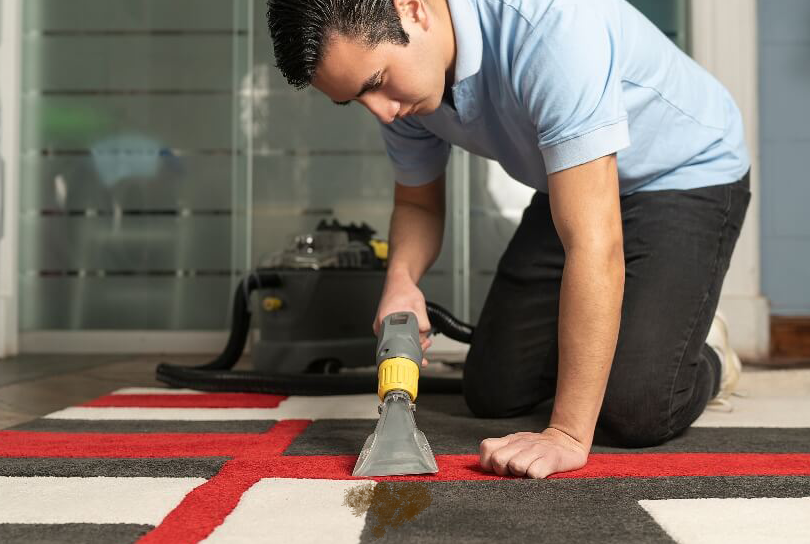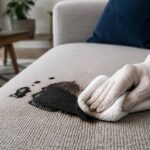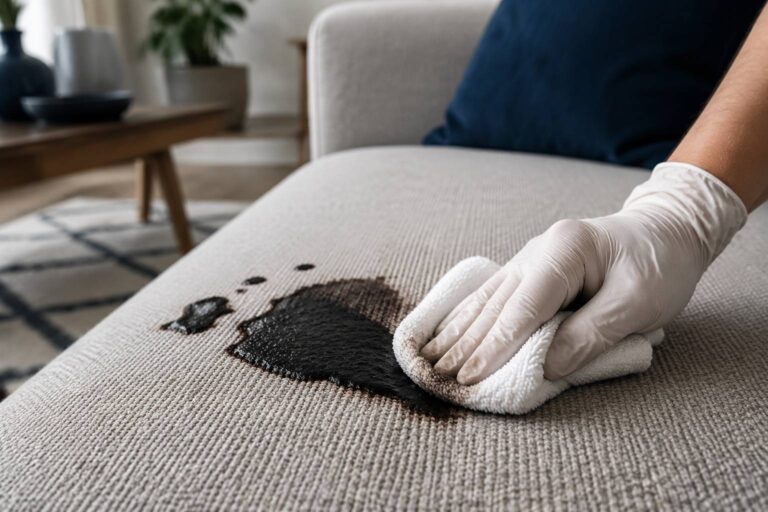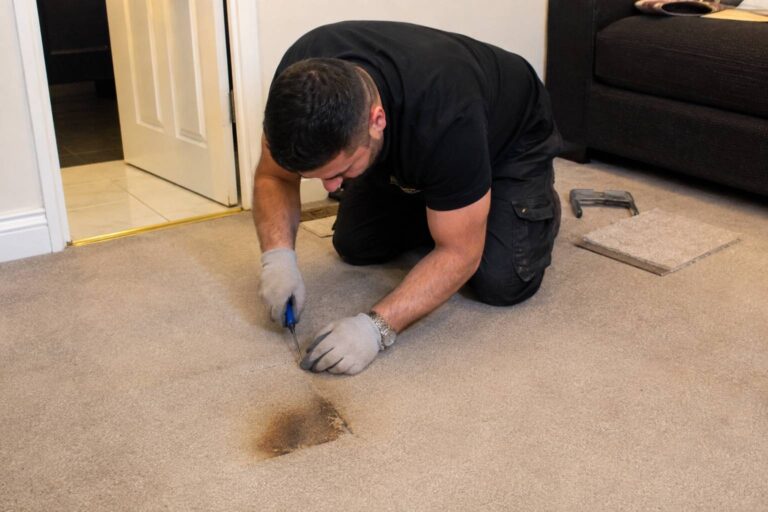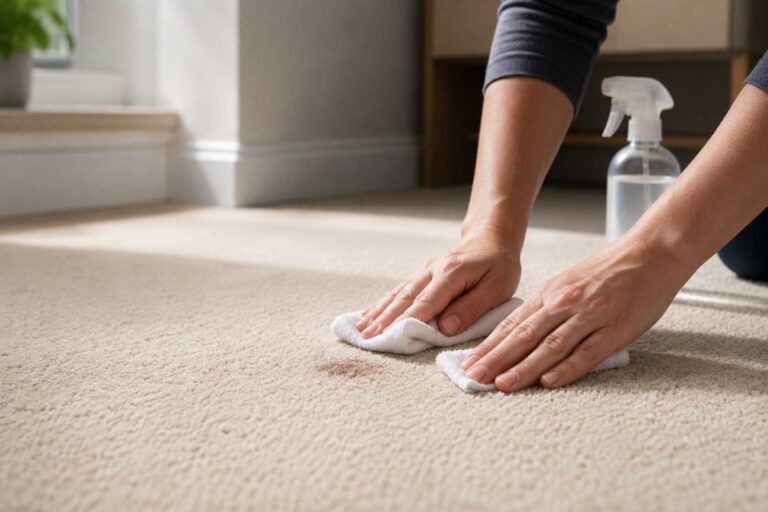
Foundation should be removed from carpet by first lifting away the excess, then blotting from the outside of the stain towards its centre. Vacuum loose powder before applying moisture. For liquid or cream foundation, use a small amount of carpet-safe cleaning solution on a white cloth, rinse by controlled blotting and allow the carpet to dry fully.
Foundation can be difficult to remove because it usually contains a combination of pigments, oils, waxes or long-wear ingredients. Using too much water, rubbing the carpet or pouring cleaner directly onto the mark can spread these ingredients through the pile and leave a larger stain.
The safest approach depends on whether the foundation is a loose powder, liquid, cream or dried product, as well as the type of carpet affected.
| Foundation type | First action | Main risk |
|---|---|---|
| Loose powder | Lift any solids and vacuum carefully | Moisture can turn the powder into a paste |
| Liquid or cream | Lift the excess and blot inwards | Rubbing can spread oils and pigment |
| Long-wear or waterproof | Use a tested carpet-safe treatment sparingly | Persistent oils and pigments may remain |
| Dried foundation | Gently loosen surface residue before blotting | Forceful scraping can damage the fibres |
What Should You Do Immediately After Spilling Foundation?
Acting quickly can improve the chance of removing the mark, but speed should not come at the expense of control. The aim is to contain the foundation before attempting to dissolve or rinse it.
Follow these first steps:
- Keep people and pets away from the affected area so the foundation is not walked further into the carpet.
- Use the edge of a spoon or a blunt scraper to lift blobs of liquid or cream foundation.
- Do not press down or drag the foundation across the surrounding fibres.
- If the product is a loose powder, vacuum it before introducing any moisture.
- Blot liquid foundation with a clean white cloth, beginning at the outside edge and moving towards the centre.
- Check the carpet’s care instructions and test your intended cleaner in a hidden area.
Always blot rather than rub. Scrubbing can push the pigment deeper into the pile and spread the stain beyond its original boundary.
What Will You Need?
Prepare everything before you begin so that you do not leave the stain untreated while searching for supplies.
You may need:
- A spoon or blunt plastic scraper
- A vacuum cleaner for powder foundation
- Several clean white cloths or plain white kitchen roll
- Cool or lukewarm water
- A stain remover specifically labelled as suitable for carpets
- Dry white towels
- Protective gloves
White cloths make it easier to see whether foundation is transferring out of the carpet. They also reduce the risk of dye from a coloured cloth transferring onto pale fibres.
Avoid applying bleach, nail varnish remover, acetone or an untested solvent. These products may remove the carpet’s colour, weaken its backing or leave a permanent light patch.
How to Remove Liquid or Cream Foundation from Carpet
Liquid and cream foundations should be treated as both oily and pigmented stains. Removing the excess before applying a cleaning product is therefore particularly important.
1. Lift Away the Excess Foundation
Use a spoon or blunt scraper to lift as much foundation as possible. Work carefully underneath the product rather than pressing it down into the pile.
Wipe the spoon after each lift so that foundation is not transferred back onto a clean section of carpet.
2. Blot from the Outside Towards the Centre
Press a clean white cloth gently against the outer edge of the mark. Move gradually towards the centre, changing to a clean section of cloth whenever foundation transfers onto it.
Working inwards helps contain the mark. Rubbing from the middle outwards can enlarge the stained area.
3. Test a Carpet-Safe Cleaning Product
Check that the product is suitable for your carpet fibre and test it in a hidden area first. Wait for the test patch to dry before checking for colour loss, texture changes or dye transfer.
Apply a small amount of the product to a clean cloth rather than pouring it directly over the carpet. This gives you more control over the amount of moisture and the size of the treated area.
If you do not have a suitable carpet stain product, do not experiment with several household cleaners. In particular, wool, sisal, jute and other sensitive materials can react badly to unsuitable chemistry or excess water.
4. Blot the Stain Repeatedly
Press the treated cloth against the foundation mark without scrubbing. Continue moving to a clean part of the cloth as the foundation transfers.
You may need to repeat this process, but adding more cleaner is not always more effective. Small, controlled applications are safer than saturating the carpet.
If the carpet’s own colour begins transferring to the cloth, stop immediately. Carpet dye transfer is different from foundation pigment coming out of the pile and may indicate that the treatment is affecting the carpet itself.
5. Remove the Cleaning Residue
Lightly dampen a second white cloth with clean, cool or lukewarm water. Blot the treated area to remove the remaining cleaning solution.
Do not pour water over the stain. Excess moisture can carry foundation and detergent further through the pile, wet the backing or contribute to a visible ring as the carpet dries.
6. Dry the Carpet Properly
Press a dry towel firmly over the area to absorb as much moisture as possible. Allow air to circulate through the room and keep people, pets and furniture away from the treated section until it is completely dry.
Do not use a hairdryer or portable heater directly on the carpet. Concentrated heat may affect delicate fibres, dyes, backing materials or adhesives.
For more detailed aftercare, see our guide to how long carpet takes to dry after cleaning.
How Should You Remove Powder Foundation from Carpet?
Powder foundation requires a different first step because adding liquid too soon can turn the powder into a paste.
Begin by picking up any broken pieces of compact foundation without crushing them into the carpet. Carefully vacuum the remaining loose powder, keeping the vacuum head above the stain initially so that it does not drag pigment across the pile.
Avoid brushing the area aggressively. Fine powder can move quickly between fibres and spread beyond the visible mark.
Once the loose material has been removed, inspect the carpet. If pigment remains, treat the small affected area using the controlled blotting method described above.
What If the Foundation Has Already Dried?
Dried foundation can often still be improved, but it may require more patience. Long-wear, transfer-resistant and waterproof foundations can be particularly persistent because they are designed to remain in place when exposed to moisture.
Use a spoon or blunt scraper to lift loose surface residue gently. Do not scrape hard enough to pull, fray or distort the carpet fibres.
Apply a small amount of tested carpet-safe cleaner to a white cloth and blot from the outer edge towards the centre. Repeat only while you can see foundation transferring onto the cloth.
If repeated controlled blotting produces no further transfer, stop. Increasing the amount of cleaner or combining different products can leave residue, affect the carpet colour or create a larger mark than the original stain.
Does the Carpet Fibre Change the Cleaning Method?
Yes. A method that is tolerated by a colourfast synthetic carpet may damage wool or a moisture-sensitive natural fibre.
Synthetic Carpets
Many synthetic carpets are relatively tolerant of controlled spot treatment. However, you should still check the care instructions, patch-test the cleaner and avoid overwetting the backing.
Wool Carpets
Wool requires greater care because unsuitable alkaline products, bleach, aggressive agitation and excess water can affect the fibres or dyes.
Lift the excess foundation and blot gently. Use only a cleaner confirmed as suitable for wool and stop if the carpet colour begins to transfer.
Our guide to removing red wine from a wool carpet without fading the colour provides further advice about patch testing, controlled moisture and protecting wool carpet dyes.
Sisal, Jute and Other Natural Plant Fibres
Natural plant fibres can develop water marks, browning, shrinkage or texture changes after wet treatment. A small foundation stain can become more noticeable if a large area is dampened.
After removing loose or excess foundation, it may be safer to arrange a professional assessment rather than attempting repeated wet treatments.
Unknown or Colour-Sensitive Carpets
If you do not know what the carpet is made from, treat it as sensitive. Avoid experimenting with multiple products and do not assume that a cleaner described as suitable for “most carpets” is safe for every fibre or dye.
Can Washing-Up Liquid Remove Foundation from Carpet?
A very dilute mild washing-up liquid may help break down oily foundation on some colourfast synthetic carpets, but it is not suitable for every carpet.
Too much washing-up liquid can leave sticky residue behind. That residue may attract dirt and cause the treated section to appear darker again after it dries.
If the carpet manufacturer permits this type of treatment, use only a very small amount in water, apply it to a cloth rather than directly to the carpet and rinse it out by controlled blotting. For wool, natural fibres or an unknown carpet, use a suitable carpet product or seek professional advice instead.
Can Micellar Water Remove Foundation from Carpet?
Micellar water can dissolve certain make-up formulations, but it should not be treated as a universal carpet cleaner. Different products can contain oils, fragrances and surfactants that may leave residue or affect sensitive fibres.
If you intend to use micellar water, first test a very small amount in a hidden part of a suitable colourfast carpet. Apply it to a white cloth rather than pouring it over the stain, and blot away any residue afterwards with a separate cloth lightly dampened with clean water.
Do not use it on wool or another sensitive carpet unless its suitability has been confirmed.
Which Mistakes Can Make a Foundation Stain Worse?
Several common responses can turn a small make-up mark into a larger cleaning problem.
Rubbing the Stain
Rubbing moves pigment sideways through the carpet and can drive oily foundation deeper into the pile. It may also disturb the texture of looped, wool or delicate fibres.
Pouring Cleaner Directly onto the Carpet
This makes it difficult to control the amount of solution and the size of the treated area. The liquid may also reach the carpet backing before it can be extracted.
Using Too Much Water
Flooding the spot can spread dissolved foundation beyond the visible mark. Excess moisture may also increase drying time and contribute to water marks, odour or damage to the backing.
Using Hot Water Without Checking Suitability
Hot water is not automatically more effective. The appropriate temperature depends on the carpet fibre, dyes, stain and cleaning product being used.
Mixing Cleaning Products
Never combine stain removers or household chemicals. Mixing products can create unsafe reactions, affect the carpet’s colour or leave residues that are more difficult to remove than the original foundation.
Continuing After the Carpet Reacts
Stop immediately if the carpet’s colour transfers, its texture changes or the affected area becomes larger. Continuing the same treatment is unlikely to correct the reaction.
How Can You Prevent a Water Mark or Sticky Patch?
A water mark is more likely when the treated area is heavily saturated or dries unevenly. Sticky patches usually develop when too much detergent remains in the pile.
To reduce these risks:
- Use the smallest practical amount of cleaning solution.
- Apply the solution to a cloth instead of pouring it onto the carpet.
- Keep your blotting within the affected area.
- Remove detergent residue with a lightly dampened clean cloth.
- Absorb moisture with dry towels.
- Maintain gentle airflow across the room.
- Keep furniture and foot traffic off the carpet until it is fully dry.
The surface may feel dry while moisture remains deeper in the pile. If you are uncertain about drying and aftercare, our article explaining what to expect during professional carpet cleaning covers spot treatment, rinsing, extraction and drying in more detail.
When Should You Call a Professional Carpet Cleaner?
Consider professional treatment when:
- The carpet is wool, natural-fibre, handmade, antique or high-value.
- The foundation stain is large or has reached the backing.
- The foundation is waterproof, heavily pigmented or fully dried.
- Several cleaning products have already been applied.
- The carpet’s colour or texture has started to change.
- A ring remains after the treated section dries.
- The mark continues returning after cleaning.
- You do not know the carpet fibre or the products previously used.
Professional treatment does not guarantee that every foundation stain can be removed. The result depends on the cosmetic formula, carpet fibre, dye stability, age of the stain and any earlier cleaning attempts.
Our spot and stain removal service in London uses treatments selected according to the affected material and the type of stain. For carpets that also require wider cleaning beyond the make-up mark, our professional carpet cleaning service in London uses hot water extraction with controlled moisture.
Before booking, send clear photographs of the stain and surrounding carpet, together with the carpet material if known, the type of foundation and details of anything already applied. This helps us provide a more useful initial assessment.
Frequently Asked Questions
How do you remove foundation from a wool carpet?
Lift away the excess foundation and blot the area gently with a clean white cloth. Avoid bleach, strong alkaline cleaners, aggressive rubbing and excess water. Use only a product confirmed as suitable for wool after testing it in a hidden area. For a large, oily or dried stain, professional treatment is safer.
How do you remove dried foundation from carpet?
Gently lift loose dried residue using a spoon or blunt scraper. Apply a small amount of tested carpet-safe cleaner to a white cloth and blot from the outside towards the centre. Repeat only while foundation continues transferring onto the cloth, and do not saturate or scrape the carpet aggressively.
Will foundation permanently stain carpet?
Foundation can permanently mark carpet, particularly when it is highly pigmented, oil-based, waterproof, old or repeatedly rubbed into the fibres. Prompt and controlled treatment improves the chance of removal, but the final result depends on both the cosmetic formula and the carpet material.
Can you use a carpet-cleaning machine on a foundation stain?
A carpet-cleaning machine should not be the first response to a small foundation stain. It may spread a concentrated spot or wet a much larger area before the make-up has been properly pre-treated. Remove the excess and treat the mark locally first. Extraction should only be used when suitable for the carpet.
Can baking soda remove foundation from carpet?
Baking soda may absorb some surface oil, but it does not reliably remove the pigments and film-forming ingredients found in foundation. It may also become difficult to remove from dense or damp carpet. A product intended for the carpet fibre is a more controlled choice.
Why has the foundation stain returned after drying?
A stain may return when dissolved foundation moves upwards from deeper in the pile or backing as moisture evaporates. Residual detergent can also attract soil and make the area appear dark again. If the mark returns after controlled treatment, avoid repeatedly soaking it and arrange a professional assessment.