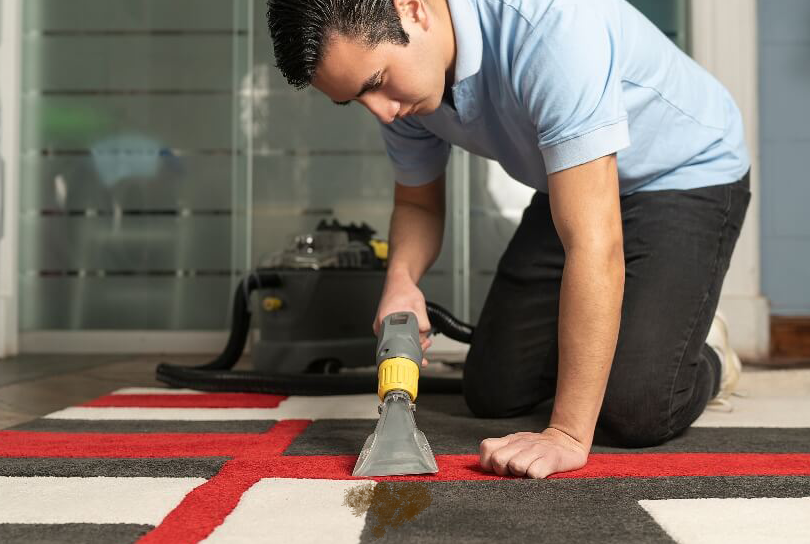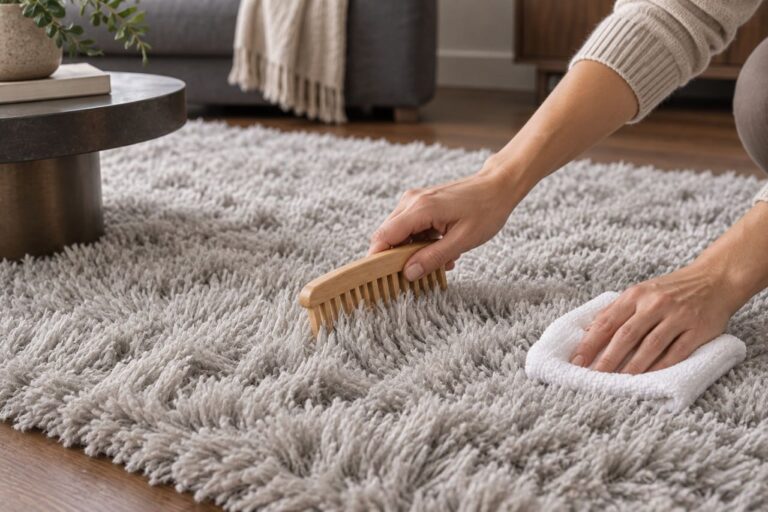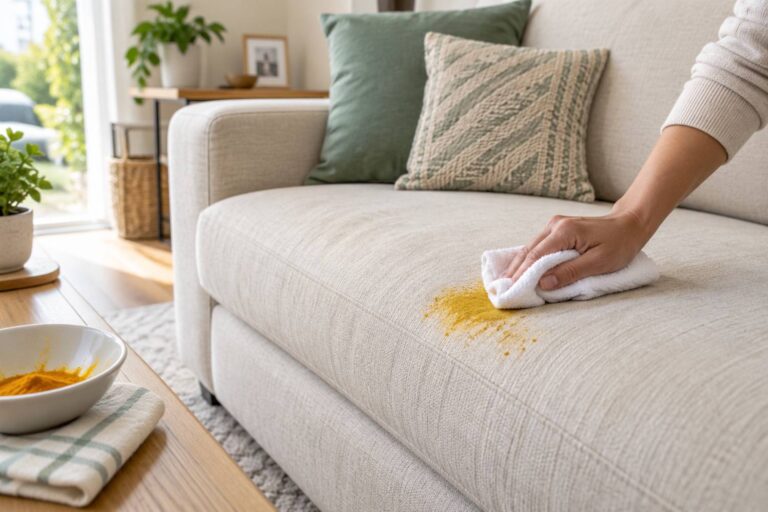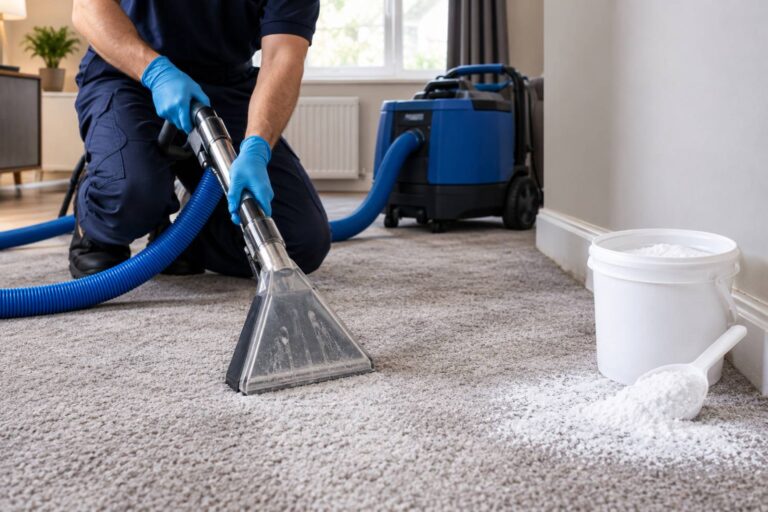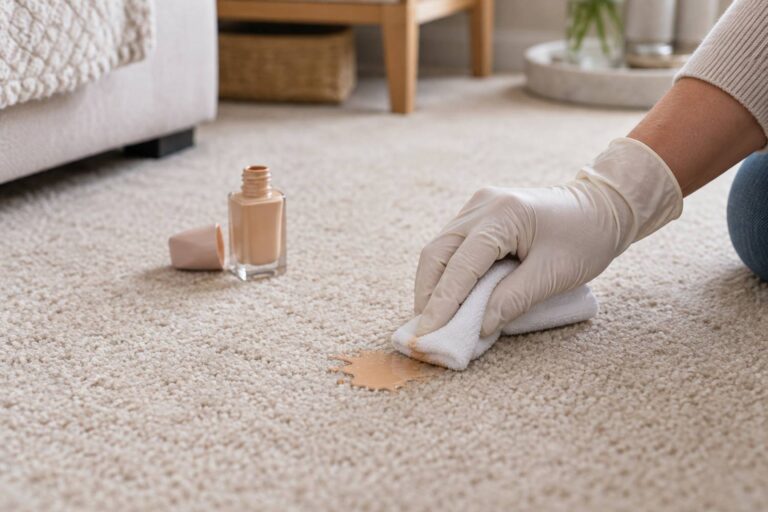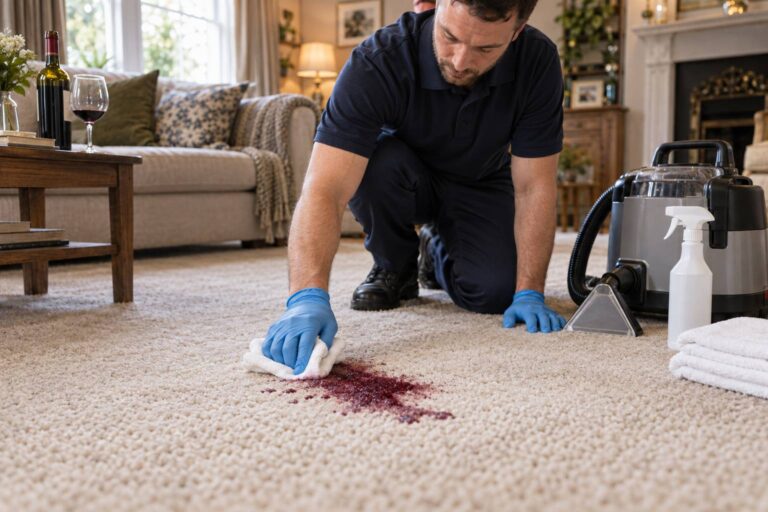
To remove pet urine smell from carpet, blot fresh urine immediately without rubbing, then treat the affected area with a carpet-safe enzymatic pet cleaner according to the product instructions. Allow the carpet to dry completely. If the smell returns after drying, especially in warm or humid conditions, urine may have penetrated the carpet backing or underlay and require deeper treatment.
Key Takeaways
- Blot fresh urine as quickly as possible rather than rubbing or scrubbing it.
- An enzymatic cleaner is usually the most useful home treatment for breaking down the organic residue responsible for lingering pet urine odour.
- Avoid repeatedly soaking the carpet, using very hot water or applying several different cleaning products on top of one another.
- Old or repeated accidents may have reached the carpet backing or underlay, which can explain why the pee smell returns after the surface appears clean.
- Wool, natural-fibre and delicate carpets require more caution because excessive moisture or unsuitable cleaning products can cause colour or fibre damage.
- If the smell repeatedly returns after home treatment, a targeted spot and stain removal service may be more appropriate than repeatedly treating the area yourself.
How to Remove Pet Urine Smell from Carpet Step by Step
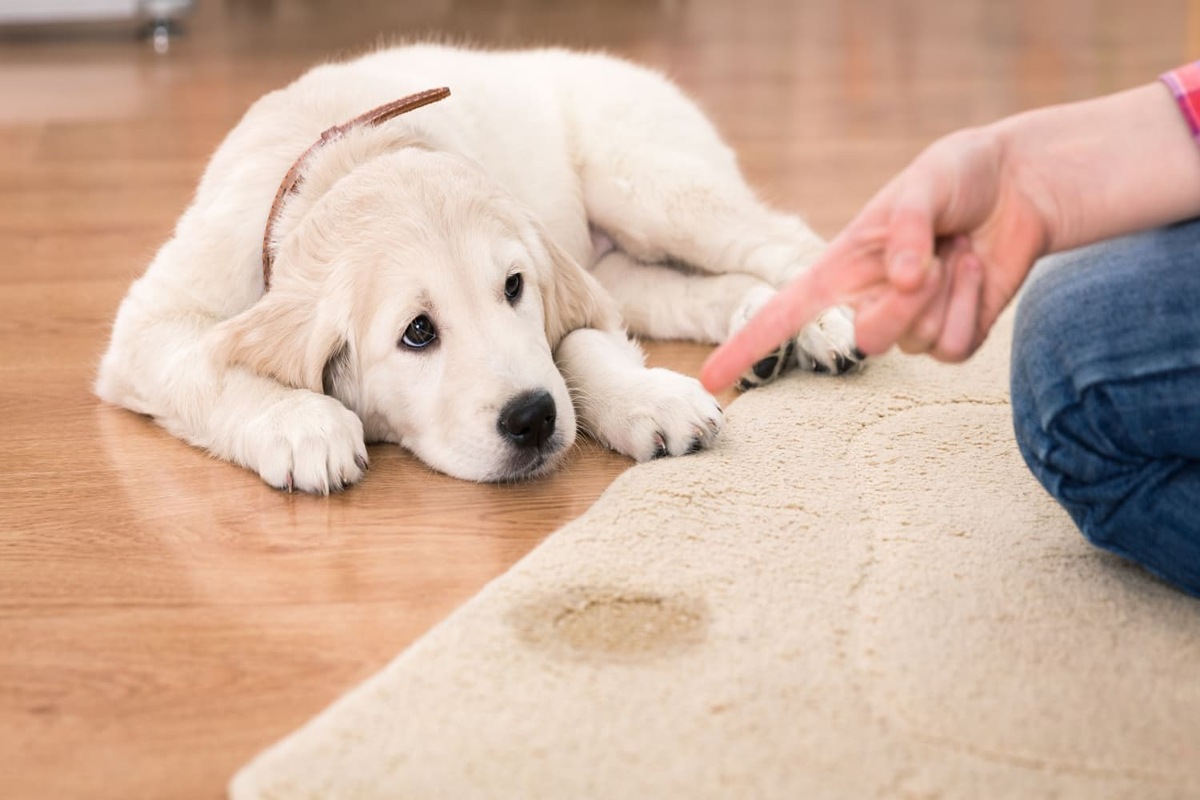
If you have just discovered a fresh accident, acting quickly gives you the best chance of removing both the moisture and the smell before it travels deeper into the carpet.
Step 1: Blot Up as Much Urine as Possible
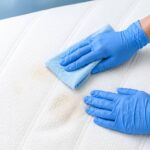
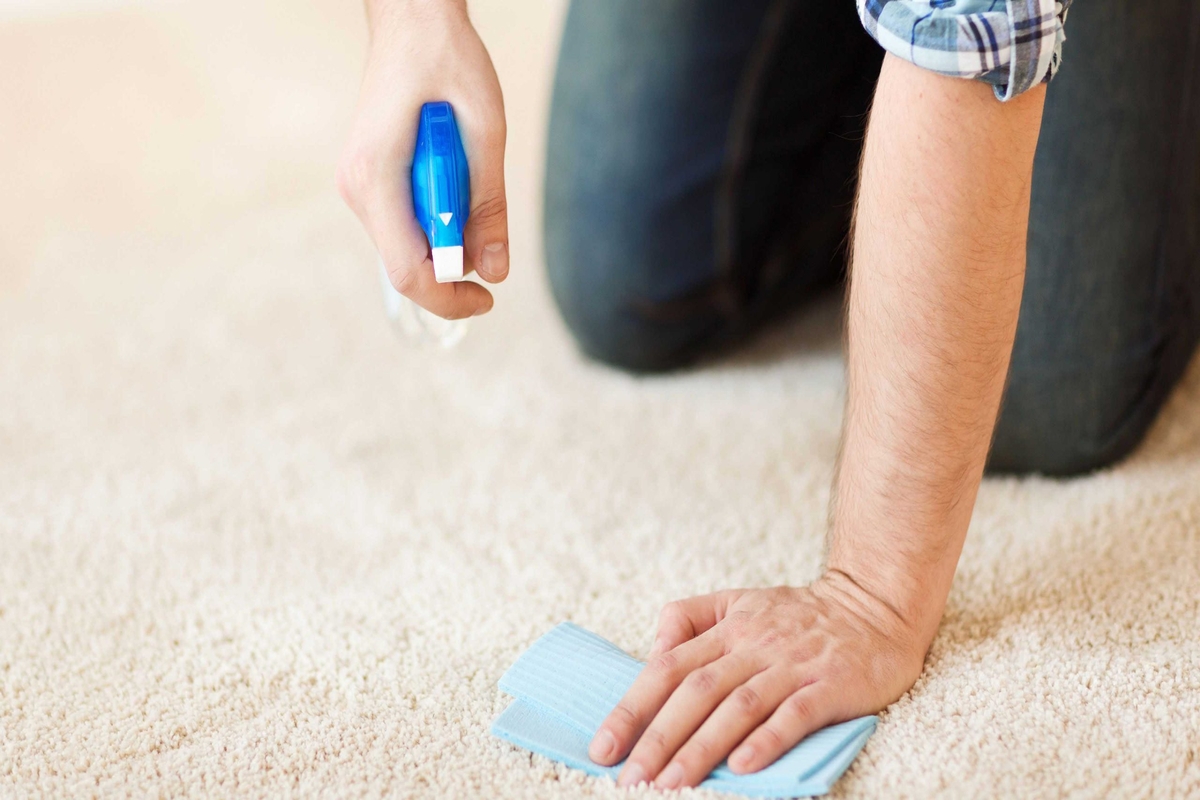
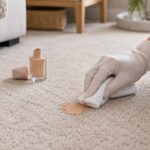
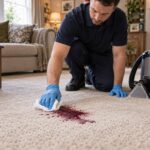
Place clean white paper towels or a white absorbent cloth over the wet area and press firmly. Do not scrub from side to side. Scrubbing can spread the affected area and push moisture further into the carpet. Replace the towels as they become wet and continue blotting until very little moisture transfers onto them. For a larger accident, remember that the affected area beneath the surface may be wider than the visible wet patch.
Step 2: Use a Carpet-Safe Enzymatic Pet Cleaner
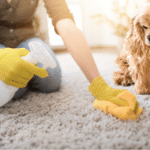
After removing as much liquid as possible, use an enzymatic cleaner specifically designed for pet urine and suitable for your carpet type.
Always:
- check the carpet care instructions;
- patch-test the cleaner in an inconspicuous area;
- follow the product’s recommended application amount and dwell time;
- keep pets and children away from the treated area until instructed by the manufacturer.
Enzymatic products are designed to break down organic residues rather than simply covering the smell with fragrance.
Avoid mixing an enzyme cleaner with other household cleaning products. Combining several products can reduce their effectiveness and may leave additional residue in the carpet.
Step 3: Blot Excess Moisture and Let the Carpet Dry
Once the product has had the recommended contact time, follow the manufacturer’s instructions for blotting, extracting or leaving the treatment to dry. Improve airflow by opening windows when weather conditions allow or using a fan.
Do not judge the result while the carpet is still damp. The surface may dry before the carpet backing or underlay beneath it. If you are unsure how long the area should remain unused, our guide explaining how long carpet takes to dry after cleaning covers the main factors that affect drying time.
Step 4: Check the Area Again Once It Is Fully Dry
Once the carpet is dry, smell the area again from several directions rather than checking only the centre of the original stain. If the smell has disappeared, no further treatment may be necessary. If the smell becomes noticeable again after a few hours, the following day or during humid weather, contamination may still remain deeper in the carpet. This is particularly common after larger accidents or repeated urination in the same place.
Where dampness or visible growth is involved, first check whether a mould-affected carpet can be cleaned or should be replaced.
How to Get Pet Urine Smell Out of Carpet When the Urine Has Dried
Old pet urine is more difficult to deal with because the visible moisture has disappeared while residue may remain within the carpet pile, backing or underlay.
Start by identifying the full affected area. The original stain may no longer be clearly visible, so avoid assuming that the strongest-smelling point is the only contaminated section.
Apply a carpet-compatible enzymatic urine treatment according to its instructions and give it the full recommended dwell time.
Do not repeatedly soak the area in an attempt to reach deeper contamination. Adding excessive moisture can spread dissolved residue further through the carpet structure and make drying more difficult.
If an old pet accident also leaves a visible mark that disappears and then returns after cleaning, read our guide to why carpet stains come back after cleaning. Wicking from deeper contamination is one possible explanation.
Why Does My Carpet Still Smell Like Urine After Cleaning?
A carpet can appear clean while still smelling of urine because the visible pile is only the top layer of the flooring system.
Urine can travel through:
carpet fibres → carpet backing → underlay → flooring beneath
How far it travels depends on the volume of urine, how quickly it was treated, the carpet construction and whether the same area has been affected more than once.
The Urine Has Reached the Carpet Backing or Underlay
This is one of the main reasons pet urine smell keeps coming back.
Surface cleaning may improve the carpet pile while leaving contamination underneath. Moisture or increased humidity can then make the odour more noticeable again.
This does not automatically mean the underlay needs replacing. The appropriate treatment depends on how deeply and extensively the contamination has spread.
The Area Was Not Fully Dry
A carpet that remains damp can temporarily smell stronger after cleaning.
Before applying another cleaner, allow the area to dry completely and reassess it.
Repeatedly adding more liquid before the previous treatment has dried can make it difficult to determine whether the original urine or excess moisture is responsible for the remaining odour.
The Product Masked the Smell Rather Than Treating the Source
Fragranced sprays and general household deodorisers may make a room smell fresher temporarily without removing urine residue.
If the smell disappears immediately after spraying but returns once the fragrance fades, the underlying contamination probably still needs treatment.
The Same Area Has Been Used Repeatedly
Several small pet accidents in one location can create a much larger contaminated area beneath the carpet than is visible from above.
This is why a patch that appears minor can sometimes continue to smell despite repeated surface cleaning.
Pets can leave more than just smells behind, see whether carpet cleaning removes fleas too.
Fresh Urine vs Old Urine: What Should You Do?
Situation | Best First Step | Main Risk | When to Consider Professional Help |
Fresh, wet accident | Blot immediately and use a suitable pet urine treatment | Pushing urine deeper by scrubbing | If a large amount has soaked through |
Dried urine stain | Treat with a suitable enzymatic cleaner | Repeated over-wetting | If odour remains after proper treatment |
Smell keeps returning | Assess whether contamination is deeper than the pile | Treating only the surface repeatedly | If backing or underlay may be affected |
Repeated accidents in the same area | Treat the full affected area rather than only the visible spot | Wider hidden contamination | Professional inspection may be useful |
Wool or delicate carpet | Use very cautious fibre-specific treatment | Colour run, shrinkage or fibre damage | Seek specialist advice before intensive DIY cleaning |
Can Vinegar Remove Pet Urine Smell from Carpet?
Diluted white vinegar can help with some fresh urine residues and is commonly used as a household first-aid treatment. However, it should not be treated as a guaranteed solution for dried or deeply absorbed pet urine. If you choose to use vinegar, patch-test the carpet first and avoid saturating the area.
More importantly, do not keep adding vinegar, detergent, enzyme cleaner and other stain removers one after another. Different products can interact or leave residues that complicate later treatment. For persistent pet urine odour, a product specifically designed for pet urine is generally a more targeted option.
Does Baking Soda Get Rid of Pee Smell in Carpet?
Bicarbonate of soda can help absorb light residual odours, but it does not replace proper urine treatment. If you use it, the carpet should first be properly treated and allowed to dry. Avoid applying large quantities to dense or delicate carpets where the fine powder may be difficult to remove completely. For a strong urine smell or repeated pet accidents, simply covering the area with baking soda is unlikely to resolve the source of the problem.
What Not to Do When Removing Pet Urine Smell
Don’t Scrub the Carpet
Scrubbing spreads moisture sideways, disturbs the pile and can push contamination deeper. Blot instead.
Don’t Use Ammonia-Based Cleaners
Ammonia-based products are a poor choice for areas repeatedly used by pets. The smell may resemble components of urine and can make the area attractive for remarking, particularly for cats.
Avoid High Heat on Untreated Pet Urine
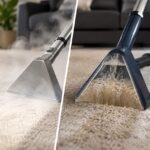
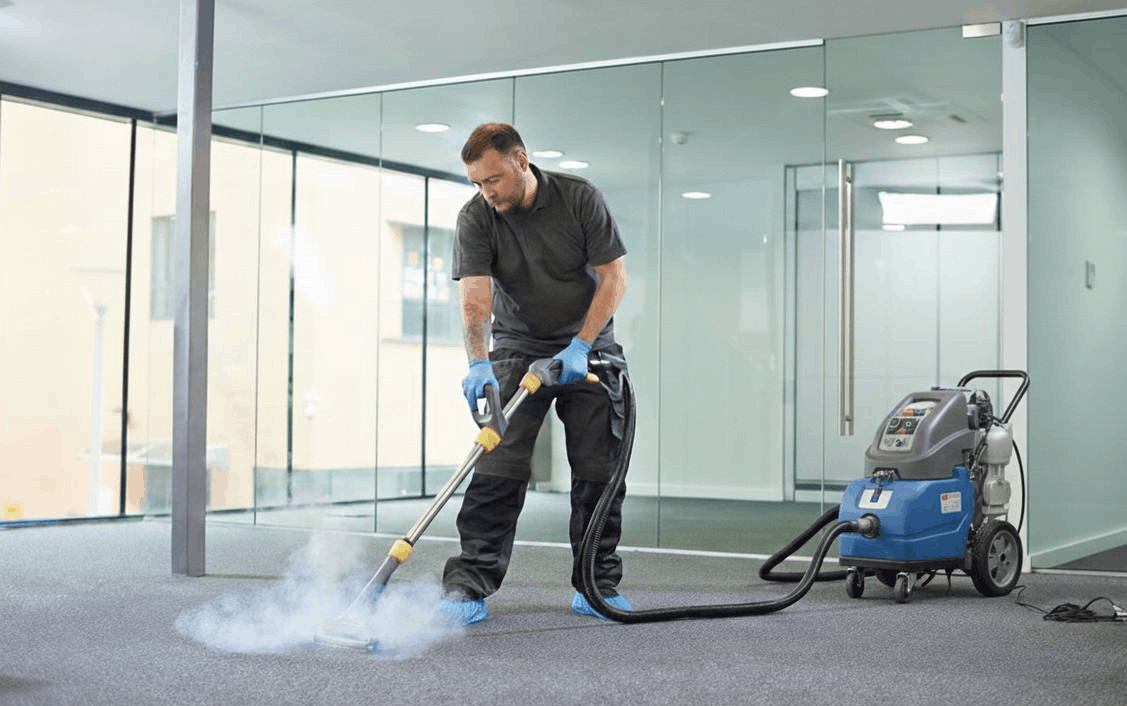
Do not immediately attack a fresh pet accident with very hot water or a domestic steam machine. Start by removing the urine and treating the contamination correctly. Professional hot water extraction can still form part of an appropriate treatment, but the method, temperature, pre-treatment and extraction need to match the carpet and the severity of the contamination.
Don’t Over-Wet the Carpet
More liquid does not necessarily mean better cleaning. Excessive moisture can carry contamination further into the backing and underlay and extend drying time. If you have already heavily wet the area, allow it to dry and assess the result before adding anything else.
Don’t Keep Layering Different Cleaning Products
If one product has failed, immediately applying another chemical over the top is rarely the best next step. Residue from previous products can affect both cleaning results and the carpet itself. If you have already tried several products, tell the professional cleaner exactly what has been used before further treatment begins.
Take Extra Care with Wool and Natural-Fibre Carpets
Wool, sisal and other natural fibres can react differently from common synthetic carpets. Moisture, cleaning-product pH and the stability of dyes all need to be considered before treatment.
For an expensive wool carpet or rug, avoid aggressive DIY treatment. If a rug rather than a fitted carpet has been affected, our guide on how to get smells out of a rug explains why material and construction influence the safest cleaning method.
Before arranging a visit, review current carpet cleaning prices in London and the factors that can affect the final quote.
What If the Pet Urine Smell Comes Back After the Carpet Dries?
A returning smell usually means the source has not been completely reached or removed.
Before treating the carpet again, check:
- whether the smell returns only when the room becomes humid;
- whether the same area has been urinated on repeatedly;
- whether the carpet was heavily soaked during previous cleaning;
- whether the smell appears to come from a wider area than the original stain;
- and whether the underlay may have been affected.
If a mark also reappears alongside the smell, deeper contamination can sometimes travel back towards the surface as the carpet dries. Repeated DIY treatment is unlikely to help if the source sits below the area you can reach safely.
When Should You Call a Professional for Pet Urine Odour?
Professional assessment becomes more useful when the urine smell remains after a correctly used enzymatic treatment, repeatedly returns after drying, affects a large section of carpet, involves several accidents in the same location or may have reached the backing or underlay.
A professional cleaner can assess the fibre, construction, previous products used and likely depth of contamination before deciding whether targeted spot treatment, deeper extraction or another approach is appropriate.
For a localised pet accident, Hi Carpet Cleaner provides professional spot and stain removal in London, including treatment for pet accidents and odour-related contamination.
If the urine problem is part of wider soiling across the room, professional carpet cleaning in London may be more suitable than treating one small area in isolation.
Not every case requires a full-room clean, which is why the extent of contamination should be assessed first.
Can Professional Carpet Cleaning Remove Pet Urine Smell Completely?
Professional treatment can often significantly improve or remove pet urine odour, but the result depends on where the urine has travelled. If contamination is limited to the carpet pile and backing, treatment is generally more straightforward.
If repeated accidents have soaked extensively into the underlay or flooring beneath, surface carpet cleaning alone may not resolve the entire problem. In more severe cases, access to the underlay or replacement of contaminated material may need to be considered.
For this reason, it is better to assess the source rather than promise that every pet urine smell can be permanently removed with one cleaning treatment. If you are comparing professional treatment with another DIY attempt, our guide to DIY carpet cleaning vs hiring a professional explains the practical differences between the two approaches.
How to Prevent Pet Urine Smell from Returning
Clean new accidents as soon as possible and make sure treated areas dry fully before deciding whether the smell has gone. Avoid leaving strong fragrances over the area simply to mask the odour, and do not encourage repeated accidents by leaving residual urine untreated.
If a previously house-trained dog or cat suddenly begins urinating indoors repeatedly, cleaning the carpet addresses the flooring problem but not necessarily the reason the accidents are happening. In that situation, it may also be worth discussing the change with your vet.
Frequently asked questions
How do I get pet urine smell out of carpet?
Blot fresh urine immediately, then use a carpet-safe enzymatic pet urine cleaner according to the manufacturer’s directions. Allow the area to dry fully before judging the result. If the odour returns, contamination may have travelled into the carpet backing or underlay.
How do I remove urine smell from carpet after it has dried?
Use an enzymatic product suitable for your carpet and allow the full recommended dwell time. Avoid repeatedly soaking the area. Persistent smells from old urine may indicate deeper contamination that requires professional treatment.
How do I get the smell of wee out of carpet?
The important step is removing the source rather than covering the smell. Blot fresh liquid, treat the area with an appropriate pet urine cleaner and dry it thoroughly. Fragrance sprays alone will usually only mask the odour.
Why does my carpet still smell like pee after cleaning?
Urine may have travelled beneath the surface fibres into the backing or underlay, the carpet may still be damp, or the previous cleaner may have reduced the smell without removing the source.
Do enzyme cleaners work on pet urine?
Enzymatic pet cleaners are specifically formulated to break down organic urine residue and can be effective when used correctly. Follow the label carefully because application amounts and dwell times vary between products.
Can vinegar remove urine smell from carpet?
Diluted vinegar may help with some fresh accidents, but it is less reliable for old or deeply absorbed urine. Avoid combining vinegar with other cleaners and always patch-test the carpet first.
Will baking soda remove dog urine smell?
Bicarbonate of soda may absorb mild residual odour, but it does not replace proper urine treatment. If contamination remains in the carpet or underlay, the smell can return.
Why does pet urine smell come back when the weather is humid?
Moisture in the air can make residual urine contamination more noticeable. A smell that consistently returns in humid conditions can be a sign that contamination remains below the visible carpet surface.
Can old pet urine smell be removed from carpet?
Often it can be improved substantially, but the outcome depends on how much urine was deposited, how long it has been present and whether it reached the backing, underlay or flooring beneath.
Do I need to replace the carpet because of pet urine?
Usually not after a single minor accident. Replacement becomes more relevant when contamination is extensive, repeated, or has significantly affected the backing, underlay or subfloor. An assessment should be made before deciding to replace the carpet.