A burnt carpet can often be fixed without spare carpet. Light surface scorching may only require careful trimming, while a small hole can sometimes be rebuilt using matching fibres taken from a concealed edge. Deeper or larger burns usually require a donor piece, professional retufting or, in limited cases, carpet stretching.
The most suitable method depends on the burn’s size and depth, the carpet’s construction and whether matching fibres or donor carpet can be sourced from a hidden area. Assess the damage before cutting anything, as the wrong DIY method can make it more noticeable.
Can You Repair a Burnt Carpet Without Spare Carpet?
Yes, but the available repair options depend on how much of the carpet has been damaged.
If only the tips of the fibres have been scorched, the affected ends may be carefully trimmed away and blended into the surrounding pile. This method does not require any replacement material.
If a small number of fibres have been completely burnt or melted, matching fibres can sometimes be taken from a concealed part of the existing carpet. Possible donor areas include the edge beneath a skirting board, inside a fitted wardrobe or underneath permanent furniture.
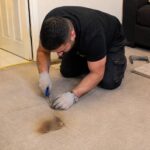
A deeper burn that has created a hole or damaged the carpet backing usually needs more than surface trimming. In this situation, a repair specialist may need to:
- Take a donor piece from a hidden part of the existing carpet
- Source a close match from an offcut or carpet sample
- Rebuild the area using individual replacement fibres
- Reposition or stretch the carpet if the burn is close to a wall
Not every repair will be completely unnoticeable. The final appearance depends on the location and size of the burn, the carpet material, the direction of the pile and how closely the donor fibres match the surrounding carpet.
Check How Deep the Carpet Burn Is Before Repairing It
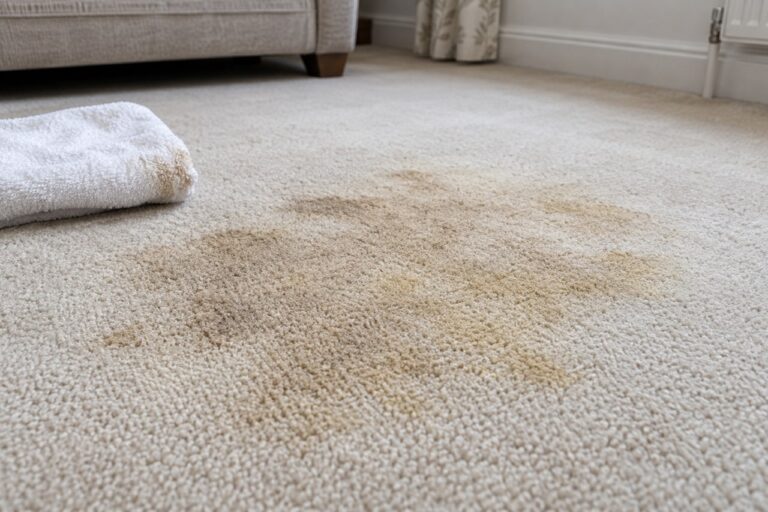
A carpet burn is permanent heat damage rather than an ordinary stain. Cleaning products may remove loose soot or surface residue, but they cannot restore fibres that have melted or burnt away.
Before choosing a repair method, allow the area to cool completely and examine it in good light. Avoid rubbing the damage, as brittle fibres may break and make the affected area larger.
Surface Scorching
Surface scorching affects only the tips of the carpet fibres. The area may look brown or black and feel rough, but there is no visible hole and the lower part of the pile remains intact.
This type of damage may be suitable for careful trimming and blending. However, trimming only works if enough healthy fibre remains beneath the scorched section.
Small Burn with Missing or Melted Fibres
A cigarette, hot ember or hair-styling tool may destroy a small cluster of fibres and leave a shallow indentation. The carpet backing may still be intact, but trimming alone would leave a visibly thin area.
This damage may be repaired by inserting individual donor fibres or professionally retufting the affected section.
Deep or Wide Burn
A deep burn may extend through the pile and into the carpet backing or underlay. Iron burns can also leave a large, clearly defined area of flattened or melted synthetic fibres.
These burns normally require a donor patch or specialist reconstruction. If the heat has weakened the backing, simply covering the area with loose fibres will not produce a secure or durable repair.
Condition of the carpet | Likely repair option | Suitable for DIY? |
Scorched fibre tips only | Trim and blend | Possibly, with care |
Very small area of missing fibres | Donor-fibre repair | Possible but high-risk |
Small, deep burn | Retufting or donor patch | Usually not |
Large burn or damaged backing | Professional patching or replacement | No |
If the burn is on a rug rather than a fitted carpet, professional rug repair in London can assess the damage and determine whether the affected fibres can be restored or replaced.
Repair Options When You Do Not Have Spare Carpet
Not having a spare offcut does not necessarily mean that the entire carpet must be replaced. Several repair methods may still be available, ranging from limited surface trimming to professional reconstruction.
Option 1: Trim and Blend a Light Surface Burn
Trimming is only suitable when the heat damage is confined to the ends of the fibres. It cannot restore fibres that have burnt away or melted down to the backing.
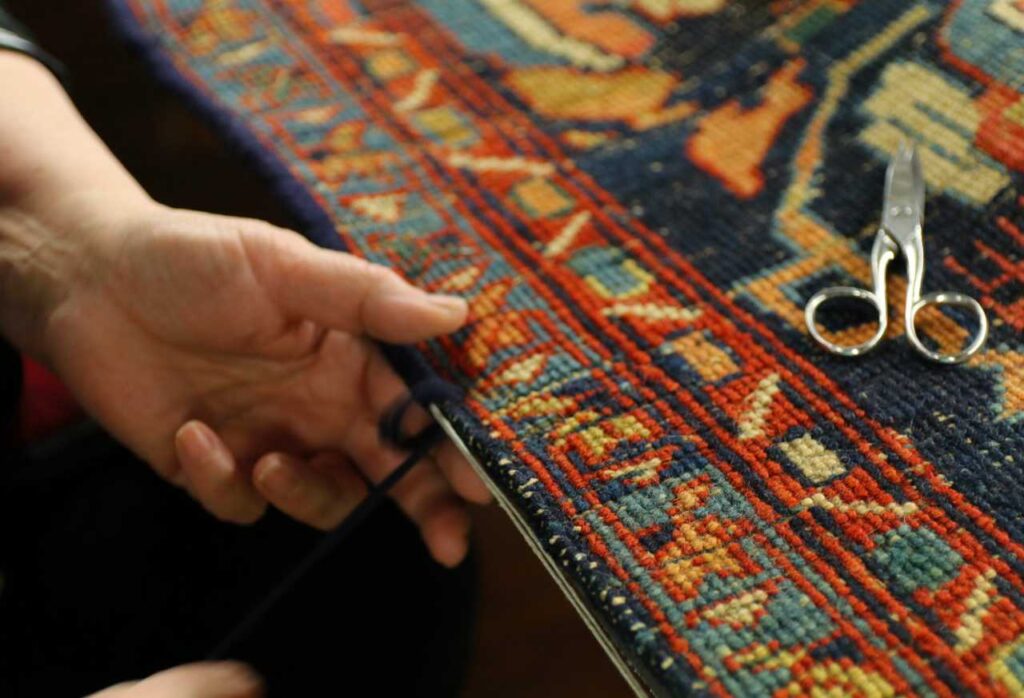
Begin by vacuuming the area gently to remove loose particles. Using small, sharp scissors, cut away only the blackened or hardened tips. Work a few fibres at a time and inspect the area after every cut.
Do not try to remove the entire mark in one deep cut. Taking too much from the pile can create a low, bald-looking patch that is more visible than the original scorch. Once the damaged tips have been removed, gently arrange the surrounding fibres to blend the repaired area.
Extra caution is necessary with loop-pile carpet. Cutting a loop may allow the yarn to pull out or unravel across a larger section. If you cannot identify how the loops are constructed, leave the repair to a professional.
Trimming is unlikely to work if the discolouration continues down the fibre or the heat has caused synthetic fibres to fuse together.
Option 2: Replace Individual Fibres from a Hidden Edge
If a very small burn has destroyed several fibres but left the backing intact, it may be possible to replace them with matching fibres from a concealed area.
Potential donor locations include:
- Beneath the edge of a skirting board
- Inside a fitted wardrobe
- Near a threshold where excess carpet is hidden
- Under furniture that is fixed permanently in place
Remove only the minimum number of donor fibres required. Taking fibres from an area that may later become visible simply transfers the damage to another part of the room.
The burnt fibres must first be removed without cutting into the backing. The donor fibres are then positioned in the same direction as the surrounding pile and secured with a very small amount of suitable carpet-repair adhesive. Once the adhesive has cured, the replacement fibres can be carefully levelled with the surrounding carpet.
Avoid ordinary household glue or superglue. These products can harden the pile, spread into surrounding fibres or leave a shiny, rigid patch.
Although this technique appears simple, matching the density, height and direction of the original pile is difficult. It is best limited to very small burns. A professional repair is safer when the damage is in the centre of the room or another highly visible position.
Option 3: Take a Donor Piece from a Hidden Area
When the damaged section is too large for individual fibre replacement, a complete donor patch may be needed. If no spare offcut exists, the donor piece can sometimes be taken from a concealed section of the installed carpet.
Common donor locations include the inside of a fitted wardrobe, beneath permanent cabinetry or under a large item of furniture that will not be moved. The concealed donor area can then be filled with a similar carpet, even if that replacement is not a perfect visual match.
A successful patch must match more than the carpet’s colour. Its fibre type, texture, pile height and pile direction must also correspond with the surrounding material. Patterned carpets require particularly precise positioning.
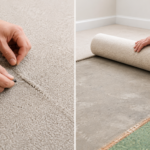
Both the burnt section and the donor piece must be cut accurately so that the edges meet without gaps or overlapping. The patch must also be aligned with the direction of the existing pile. If it is rotated incorrectly, it may appear lighter or darker even when taken from the same carpet.
Cutting a donor piece from an installed carpet is difficult to reverse. Tenants should not remove material from a fitted carpet without the property owner’s permission. See how a hidden donor section was used in a carpet burn repair case study.
Option 4: Ask a Repair Specialist to Source a Matching Donor
If the existing carpet has no suitable concealed donor area, a repair specialist may be able to find another source.
They may compare the carpet with retained offcuts, manufacturer samples or pieces from a similar product. If the carpet is still available, the original retailer or manufacturer may also be able to identify it.
However, ordering the same product does not guarantee an exact visual match. Manufacturing batches can vary, while the installed carpet may have changed because of sunlight, wear and previous cleaning. A new donor piece can therefore look brighter or slightly different from the older carpet.
A specialist should assess the donor material under the room’s normal lighting and check the pile direction before completing the repair.
Option 5: Professional Retufting or Fibre-by-Fibre Repair
Retufting can be suitable for a small but deep burn where a conventional patch would be unnecessarily large or visible.
The damaged fibres are removed and replacement yarn or donor fibres are inserted into the affected area. The repairer then adjusts their density, height and direction to reproduce the surrounding pile as closely as possible.
This method may be useful for cigarette burns, narrow straightener burns and other small areas of concentrated damage. It requires careful control of the adhesive and an understanding of the carpet’s construction. Too many replacement fibres can create a raised spot, while too few can leave the backing visible.
For that reason, retufting should not be treated as a simple DIY technique, particularly on wool, patterned or loop-pile carpets.
Option 6: Carpet Stretching or Repositioning
In limited circumstances, a burn close to a wall may be removed by repositioning the carpet.
This option is only possible if there is sufficient additional carpet at the room’s edges. A fitter may be able to release the carpet, move the damaged section towards the wall, cut it away and refit the remaining material.
Stretching is not suitable for a burn in the centre of the room. It may also be impractical where the carpet has seams, fixed transitions or insufficient excess material. Attempting to stretch it without the correct equipment can cause ripples, tension problems or gaps at doorways.
A carpet fitter or repair specialist should inspect the room before this option is considered.
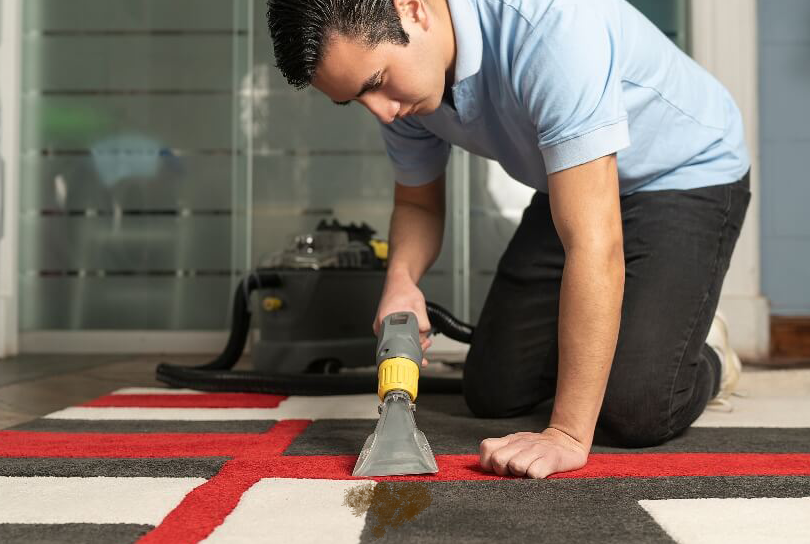
Cleaning cannot repair burnt or melted fibres, but professional carpet cleaning in London can remove surrounding soot, ash and surface residue once the damaged area has been properly assessed.
Which Repair Option Is Best for Different Types of Carpet Burns?
The object that caused the burn can provide useful clues about the likely depth and shape of the damage. The final repair decision should still be based on the condition of the fibres and backing.
Cigarette or Ember Burns
Cigarette burns are usually small and concentrated. If the ember has only scorched the fibre tips, careful trimming may be enough.
If it has created a small crater or hole, the missing pile will need to be replaced. Donor fibres or professional retufting are usually more appropriate than a large patch.
Iron Burns
An iron can damage a much wider area and often leaves a recognisable outline. On synthetic carpet, the heat may flatten and fuse the fibres even when they have not turned black.
A superficial mark may be improved by trimming, but this will not restore a large section of melted pile. A matching donor patch is often the more realistic repair option. If the backing or underlay has also been affected, the damaged layers may need to be replaced.
Hair Straightener and Curling-Tong Burns
Hair-styling tools commonly leave a narrow but relatively deep line. A small area may be reconstructed using donor fibres, while a longer burn may require a carefully cut donor strip.
If the heat has penetrated the backing, inserting surface fibres alone will not provide a lasting repair.
Candle, Coal and Hot-Ash Burns
Allow wax, coal or ash to cool before touching the area. Remove any loose solid material without rubbing it further into the carpet.
After the residue has been removed, assess the remaining heat damage. Surface scorching may be trimmed, but a crater or damaged backing will require donor material or professional retufting. Cleaning may reduce surrounding soot, but it will not reverse the burn itself.
When a DIY Burn Repair Is Likely to Make the Carpet Worse
DIY repair carries the greatest risk when precise matching or structural work is required. Professional assessment is advisable if:
- The carpet has a loop pile
- The backing is visible, burnt or weakened
- The carpet is patterned or contains several colours
- The damage is in the middle of the room
- The burn covers more than a very small cluster of fibres
- The carpet is wool, handmade or particularly valuable
- No closely matching donor material is available
- The property is rented
- The damage was caused by an iron and has a wide, defined shape
Cutting too deeply can turn a surface scorch into a permanent depression. Excess adhesive can stiffen and discolour the surrounding fibres, while a patch fitted against the pile direction may remain obvious from across the room.
If you are unsure how the carpet is constructed, stop before removing any material. A repairer may have more options while the damaged area remains intact.
If the damage is extensive or the carpet is already heavily worn, comparing carpet repair vs carpet replacement can help you decide which option offers better long-term value.
When Is Professional Carpet Burn Repair the Better Option?
Professional repair is generally the safer choice when the burn has reached the backing, the affected area is clearly visible or the carpet requires donor material that you cannot source.
A specialist can determine whether the damage is suitable for trimming, fibre replacement, retufting, patching or repositioning. They can also inspect the underlay and floor beneath a deeper burn.
Professional help is particularly worthwhile for wool and loop-pile carpets, large iron burns, patterned flooring and damage that must be repaired before the end of a tenancy. It is also advisable when an initial trimming attempt has failed or made the area uneven.
If you do not have a matching offcut, Hi Carpet Cleaner can assess whether the burn can be rebuilt with donor fibres, repaired using carpet from a concealed area or restored through another specialist technique. Our professional carpet repair in London is selected according to the carpet construction, location of the damage and depth of the burn.
A completely invisible result cannot be guaranteed. The final appearance will depend on the quality of the donor match, the age and wear of the surrounding carpet, the pile direction and the position of the repaired area.

Before choosing a repair method, check the typical carpet repair prices in London to understand how the damage type, repair technique and carpet construction may affect the cost.
Frequently Asked Questions
Can you repair a carpet burn without a spare piece?
Yes. A light surface burn may be improved by carefully trimming the damaged fibre tips. Small, deeper burns may be repaired with donor fibres or carpet taken from a concealed area. A specialist may also be able to source a close match or retuft the damaged section.
Where can I get matching carpet for a burn repair?
Matching material may be available from a hidden part of the installed carpet, the original retailer or manufacturer, a carpet sample or an offcut held by a repair specialist. Even the same carpet model may look different if the existing flooring has faded or worn over time.
Can I cut carpet fibres from under furniture?
A small number of fibres can sometimes be taken from beneath permanent furniture or another genuinely concealed area. Do not take them from a position that could become visible later, and avoid cutting loop-pile carpet unless you understand its construction.
Can you fix a small cigarette burn without replacing the carpet?
Yes, in many cases. A superficial cigarette scorch may only need careful trimming. If a small hole has formed, donor-fibre replacement or professional retufting may restore the missing pile without replacing the whole carpet.
Can an iron burn be removed from carpet?
An iron burn cannot be washed out if the heat has melted or destroyed the fibres. Depending on its depth, it may require trimming, a donor patch, retufting or replacement of the damaged section.
Will a repaired carpet burn be completely invisible?
Not necessarily. The result depends on the burn’s size and position, the carpet’s construction, the condition of the surrounding pile and the accuracy of the donor match. A good repair can make the damage considerably less noticeable, but complete invisibility should not be guaranteed.
Can carpet cleaning remove a burn mark?
No. Professional carpet cleaning may remove soot or residue around the affected area, but it cannot rebuild fibres that have been burnt or melted. Permanent heat damage requires a repair rather than cleaning alone.