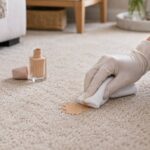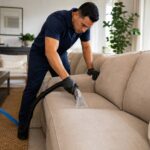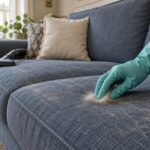
Fake tan on a fabric sofa should be treated quickly, but using too much water can leave a visible ring behind. Start by blotting the stain with a clean white cloth, check the sofa’s cleaning code, and patch-test any product first. Use only a small amount of fabric-safe cleaner and work from the outside of the stain towards the centre.
If the fabric is delicate, the care label says S or X, or the stain has already dried, professional treatment is usually the safer option.
| Question | Quick Answer |
|---|---|
| What should you do first? | Blot the fake tan immediately without rubbing. |
| Can you use water? | Only if the sofa’s cleaning code allows water-based cleaning. |
| What is the biggest risk? | Spreading the stain, fading the fabric or leaving a water mark. |
| How much cleaning solution should you use? | As little as possible. Apply it to a cloth rather than soaking the sofa. |
| When should you stop DIY cleaning? | If the colour transfers, the fabric fades, a water ring appears or the sofa has an S/X cleaning code. |
Check the Sofa Cleaning Code Before You Use Water
Before trying to remove fake tan from a fabric sofa, check the manufacturer’s care label, which is often located beneath a cushion or underneath the sofa.
You may see one of the following cleaning codes:
| Cleaning Code | What It Usually Means |
|---|---|
| W | Water-based upholstery cleaning products can usually be used. |
| S | Use a suitable solvent-based cleaning method rather than water. |
| W/S or WS | Either water-based or suitable solvent-based products may be permitted. |
| X | Vacuuming or professional cleaning is normally recommended. Avoid DIY wet cleaning. |
Even if your sofa is marked W, this does not mean the fabric should be soaked.
Over-wetting upholstery is one of the main reasons people end up with water rings, tide marks and uneven drying.
If you are unsure what your sofa fabric can tolerate, read our guide to cleaning a fabric sofa at home without damaging it.
Before booking, you can review typical sofa cleaning costs in London and the factors that affect a quotation.
What You Will Need
For a fresh fake tan stain on a water-safe sofa, you may need:
- Several clean white microfibre cloths
- White absorbent towels
- A small bowl
- A fabric-compatible upholstery cleaning product
- Cool or lukewarm water, if the care label permits it
- A spoon or blunt edge if there is excess dried product
- Good ventilation or a fan for drying
Using white cloths is important because coloured towels can transfer dye onto damp upholstery and make the problem worse.
How to Remove Fresh Fake Tan from a Fabric Sofa Step by Step
1. Blot the Fake Tan Immediately
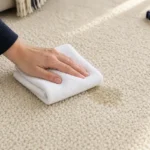
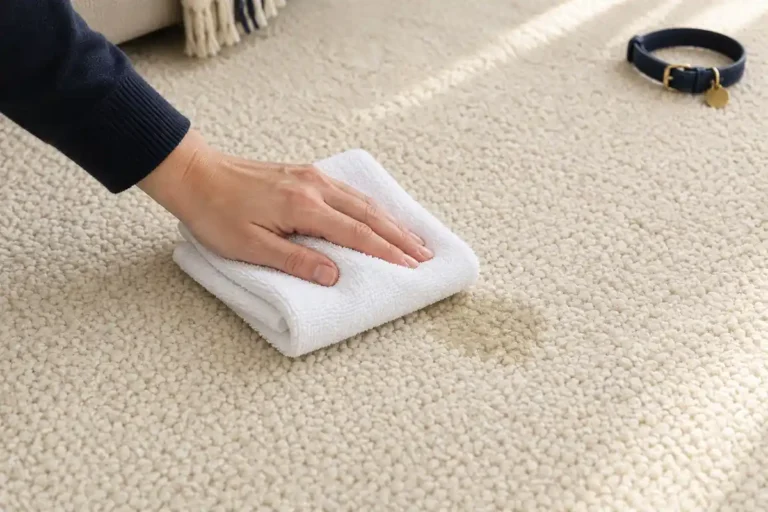
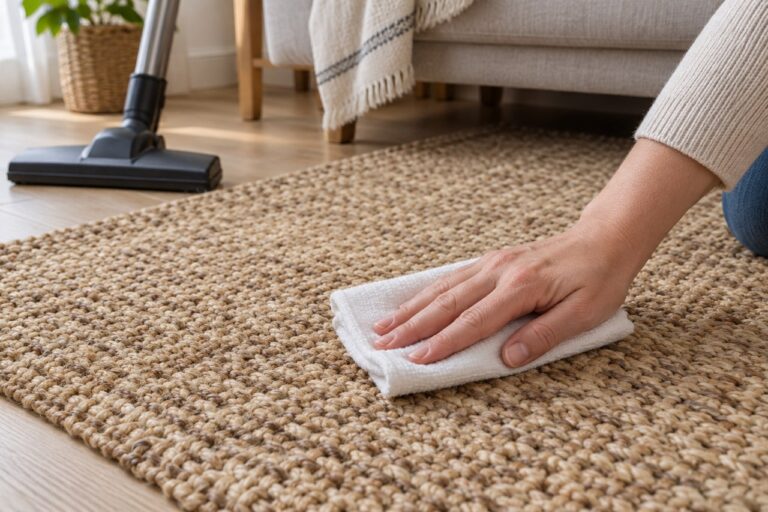
If the fake tan is still fresh, use a clean dry white cloth or absorbent towel to lift as much product as possible.
Press gently onto the stain and lift the cloth away.
Do not rub the area.
Rubbing can:
- Push the fake tan deeper into the fibres
- Spread the stain over a larger area
- Disturb the texture of the upholstery
Keep moving to a clean section of the cloth as the fake tan transfers.
If there is a thick layer of product sitting on the surface, carefully lift it with the edge of a spoon before blotting.
2. Patch-Test the Sofa
Never apply a cleaning product directly to the visible stain without testing it first.
Choose a hidden area of the sofa and apply a very small amount of the proposed cleaning solution.
Allow the test area to dry fully.
Stop if you notice:
- Colour transferring onto your cloth
- Fading
- Darkening
- A change in texture
- Stiffness
- A visible drying ring
A product may appear safe while the fabric is wet but leave a mark after drying, so do not skip the drying stage of the patch test.
3. Apply a Small Amount of Fabric-Safe Cleaner
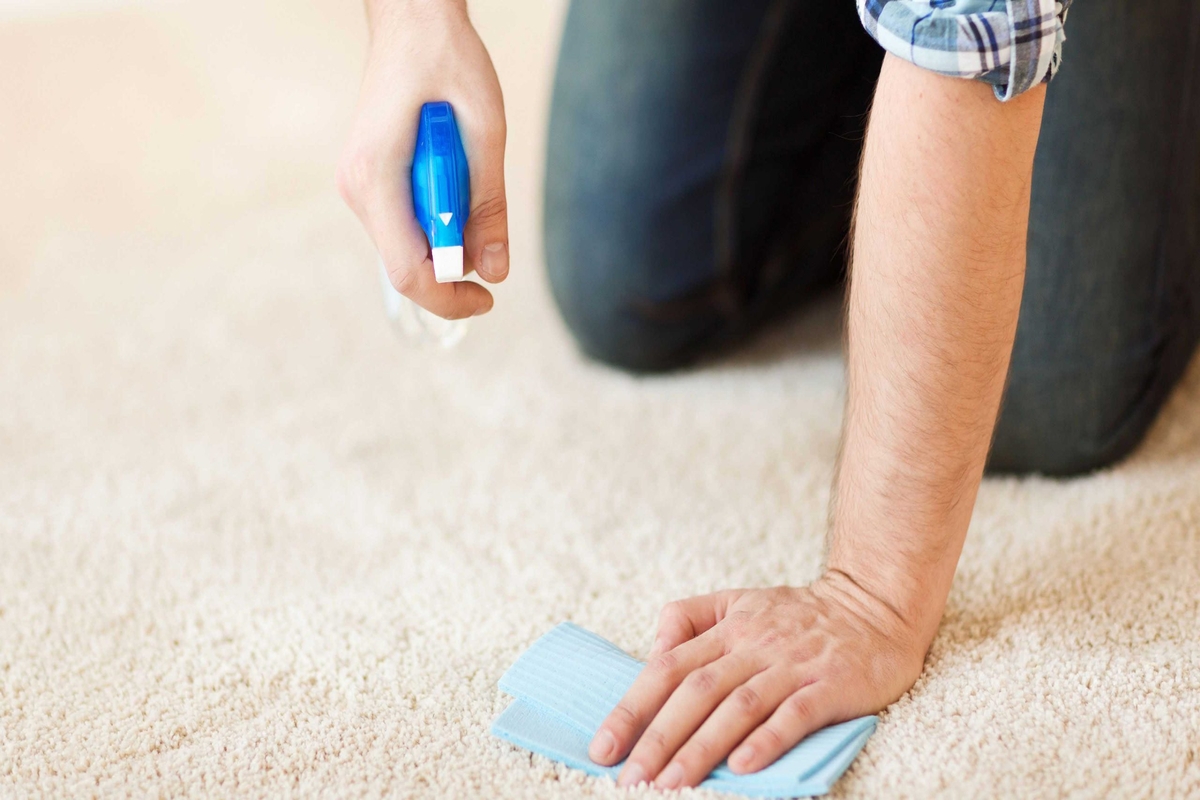
If the care code and patch test confirm that your chosen product is suitable, apply a small amount to a clean white cloth.
Do not pour or spray the cleaner directly onto the sofa.
The aim is to control the amount of moisture entering the upholstery.
Gently dab the affected area rather than saturating it.
For fake tan, repeated light blotting is usually safer than one aggressive cleaning attempt.
4. Blot from the Outside Towards the Centre
Work from the outer edge of the fake tan stain towards the middle.
This helps prevent the pigment from spreading into clean fabric.
Press the damp cloth gently onto the upholstery, lift it away and check whether colour is transferring.
Continue using clean sections of the cloth.
Avoid circular scrubbing movements.
If the stain begins to spread or the sofa dye starts transferring onto your cloth, stop.
5. Remove Cleaning Residue Without Soaking the Sofa
If the cleaning product instructions recommend removing residue and the sofa’s care code permits water-based cleaning, lightly dampen another clean white cloth with water.
The cloth should be damp, not wet.
Blot the treated area carefully to remove remaining cleaning product.
Leaving detergent or cleaning solution in the fibres can attract dirt and may also contribute to visible drying marks.
6. Dry the Sofa Evenly
Press a dry white towel against the treated area to absorb as much moisture as possible.
Then allow the sofa to dry naturally with good airflow.
You can improve drying by:
- Opening windows
- Increasing ventilation
- Using a fan nearby
- Keeping cushions upright where practical
Avoid applying concentrated heat from a hairdryer or heater.
Do not sit on the sofa until the fabric is completely dry.
After a full clean, our guide explains how long sofas take to dry after cleaning and the steps that can help avoid moisture marks.
How to Avoid Water Marks After Removing Fake Tan
Removing the fake tan is only half the job.
A sofa can look clean while damp and then develop a darker outline or pale ring as it dries.
These are often known as water marks, tide marks or drying rings.
They can appear when moisture carries:
- Dirt
- Cleaning product residue
- Fabric dye
- Minerals
- Remaining stain particles
towards the outer edge of the damp area.
To reduce the risk of water marks:
Use as Little Moisture as Possible
Do not soak the stain.
Apply cleaning solution to your cloth rather than directly onto the upholstery.
Avoid Repeatedly Wetting the Centre of the Stain
If the middle of the area becomes much wetter than the surrounding fabric, it can dry unevenly and leave a ring.
Feather the Treatment Carefully
On some water-safe fabrics, very lightly blending the moisture towards the edge of the treated area can help avoid a sharp drying boundary.
However, this must still be done with minimal moisture.
Remove Cleaning Residue
Too much detergent can dry into the fabric and create a visible mark.
Dry the Area Consistently
Uneven drying is one of the main causes of visible rings.
Good airflow across the whole treated area is usually safer than trying to dry one small section quickly.
If you already have a ring on the upholstery, see our guide on how to remove water stains from a fabric sofa without leaving rings.
What If the Fake Tan Stain Has Already Dried?
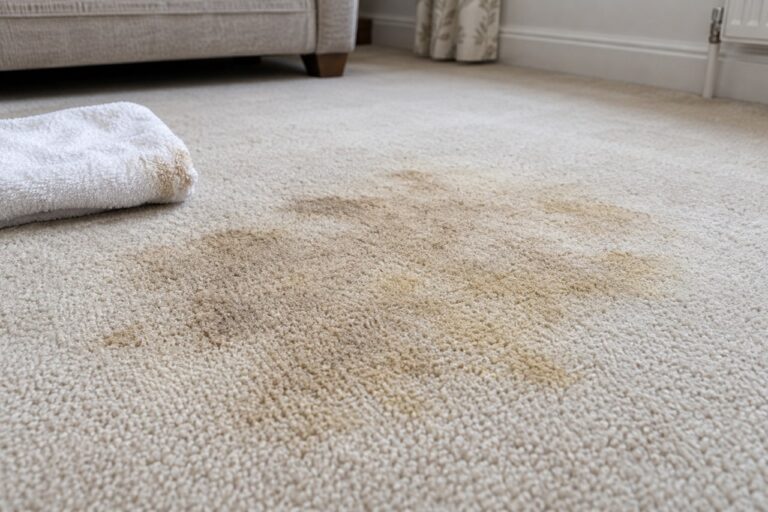
A dried fake tan stain can be more difficult to remove because the colour may have developed and settled deeper into the upholstery.
Do not immediately respond by using stronger chemicals or repeatedly soaking the sofa.
That can create a larger problem than the original stain.
Instead:
- Check the sofa care label.
- Remove any dried surface residue gently.
- Patch-test a compatible cleaning product.
- Attempt a controlled treatment using minimal moisture.
- Allow the area to dry completely before deciding whether another treatment is needed.
If the stain remains after a careful first attempt, professional spot and stain removal in London may be safer than continuing with stronger DIY methods.
Old fake tan stains may improve significantly, but complete removal is not always possible.
Can You Use Washing-Up Liquid on Fake Tan Stains?
You will often see washing-up liquid recommended for cosmetic stains.
A small amount may be tolerated by some water-safe synthetic sofa fabrics, but it should not be treated as a universal solution.
Problems can include:
- Excess foam
- Sticky residue
- Water rings
- Colour changes
- Difficulty rinsing the detergent from thick upholstery
If you do use any detergent-based product, always check the care label and patch-test it first.
A purpose-designed upholstery cleaning product is generally easier to control.
Can You Use Vinegar to Remove Fake Tan from a Sofa?
Vinegar is another common DIY recommendation, but acidity can affect some dyes, fibres and upholstery finishes.
It may also change the appearance or feel of certain fabrics.
Do not use vinegar automatically just because it is considered a household cleaning product.
The sofa’s fabric type and care instructions should always take priority.
Can You Use Bicarbonate of Soda?
Bicarbonate of soda is useful for some odour and dry-cleaning applications, but it is not necessarily the best solution for a fake tan dye stain.
When mixed into wet cleaning treatments, it can also leave powdery residue inside upholstery fibres.
If your main issue is colour transfer from fake tan, use a method specifically suited to the fabric rather than experimenting with multiple household ingredients.
Which Sofa Fabrics Need Extra Care?
Some upholstery materials are much less forgiving than others.
Extra caution is needed with:
- Velvet
- Viscose
- Wool
- Linen
- Silk
- Vintage upholstery
- Strongly coloured fabrics
- Fabrics with unstable dyes
- Sofas without a readable cleaning label
Pile fabrics such as velvet can also develop shading or texture changes if they are rubbed or dried incorrectly.
If your sofa is expensive, delicate or difficult to identify, professional upholstery cleaning in London may be the safer approach.
What Should You Avoid When Cleaning Fake Tan from a Sofa?
Avoid the following common mistakes:
- Scrubbing the stain
- Soaking the upholstery
- Using bleach
- Using acetone or nail varnish remover
- Applying harsh solvents without checking the fabric
- Mixing several cleaning products together
- Using very hot water
- Applying direct heat to speed up drying
- Machine-washing removable covers unless the manufacturer allows it
- Continuing to clean after fabric colour begins transferring
Many permanent sofa stains start as a small mark and become worse because too many different cleaning products are applied.
When Should You Call a Professional Upholstery Cleaner?
DIY treatment is not always the safest option.
Consider professional treatment if:
- The sofa has an S or X cleaning code
- There is no care label
- The fake tan stain is old
- The stain covers a large area
- The fabric is velvet, wool, viscose, silk or another delicate material
- The sofa dye transfers onto your cleaning cloth
- A water ring has already appeared
- Previous cleaning products have left residue
- The stain has soaked through into the cushion filling
- Repeated gentle treatment has not improved the mark
Hi Carpet Cleaner provides professional upholstery cleaning services in London and specialist stain treatment for sofas and other soft furnishings.
Where possible, take clear photos of the stain, the full sofa and the care label before arranging an assessment.
How to Prevent Fake Tan from Transferring onto Your Sofa
Preventing transfer is much easier than treating the stain afterwards.
After applying fake tan:
- Allow the product to dry and develop according to the manufacturer’s instructions
- Wear loose, dark clothing
- Avoid sitting directly on pale upholstery
- Place a washable throw over the sofa temporarily
- Avoid transferring wet cosmetic products onto cushions or armrests
Be particularly careful with pale cream, beige, grey and white sofas, where even a small amount of fake tan may be highly visible.
Frequently Asked Questions
Can fake tan come out of a fabric sofa?
Fresh fake tan stains can often be reduced or removed if they are treated quickly and the sofa fabric is suitable for wet cleaning. Older stains can be more difficult because the colour may have developed inside the fibres.
How do you remove dried fake tan from a sofa?
Start with the gentlest fabric-safe method recommended by the sofa care label. Avoid repeatedly soaking the fabric or applying progressively stronger household chemicals. If the stain remains, professional stain treatment may be safer.
Will washing-up liquid remove fake tan from a sofa?
It may help on some water-safe synthetic fabrics, but it is not suitable for every sofa. Too much detergent can leave residue or water rings, so always patch-test first and use minimal moisture.
How do I stop a water ring after spot cleaning a sofa?
Use very little moisture, avoid soaking the centre of the stain, remove cleaning residue where the care code permits and dry the entire treated area evenly with good airflow.
Can I remove fake tan from a polyester sofa?
Polyester upholstery is often more tolerant of cleaning than delicate natural fibres, but you should still check the sofa’s cleaning code and carry out a patch test before using water or any cleaning product.
Should I use hot water on a fake tan stain?
Hot water is not recommended as a general treatment. Heat can affect stains, dyes, fibres and upholstery finishes. Follow the sofa manufacturer’s care instructions and the directions for the cleaning product you are using.