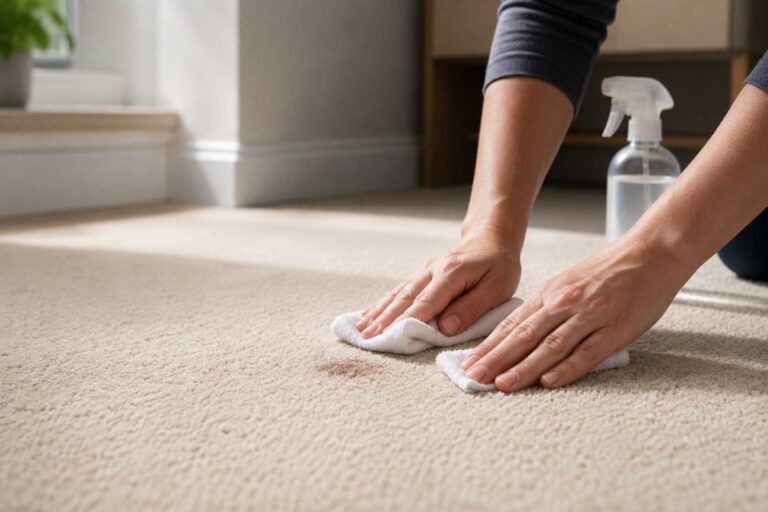
Turmeric can leave one of the most noticeable stains on a fabric sofa. Its strong yellow pigment can cling to upholstery fibres, while curry spills often contain oil, tomato, dairy or other ingredients that make the mark even harder to treat.
To remove a turmeric stain from a fabric sofa, first remove any dry powder or solid food without rubbing it into the fabric. Blot fresh liquid spills with a clean white cloth, check the sofa’s care label, and patch-test any cleaner on a hidden area before treating the stain. Use as little moisture as possible and work from the outside of the mark towards the centre.
Most importantly, avoid aggressive scrubbing, bleach and random household chemical mixtures. These may make the yellow mark lighter while permanently fading the sofa itself.
Quick Guide: What Should You Do First?
Situation | First Action |
Dry turmeric powder | Vacuum or gently lift the powder before adding any moisture |
Fresh curry or turmeric sauce | Lift solids with a spoon, then blot the liquid with a white cloth |
Dried turmeric stain | Remove loose surface residue before applying any cleaner |
W-coded sofa | Controlled water-based cleaning may be possible |
S-coded sofa | Avoid water-based DIY treatment |
X-coded sofa | Vacuum only and seek professional advice |
Colour transfers during testing | Stop immediately |
A water ring starts forming | Stop repeatedly wetting the spot and allow it to dry |
Why Are Turmeric Stains So Difficult to Remove from Sofa Fabric?
The bright yellow colour in turmeric comes largely from a pigment called curcumin. Unlike many ordinary water-based spills, this pigment does not simply rinse away with plain water.
The problem becomes more complicated when the turmeric is part of a curry.
A curry stain may contain:
- Turmeric pigment
- Cooking oil or fat
- Tomato
- Dairy products
- Other spices
- Food colouring
This means you may be dealing with both a coloured stain and a greasy stain at the same time.
It is also why flooding the area with water is rarely a good strategy. Too much moisture can spread contamination into a larger area, penetrate the cushion filling and create a visible drying ring.
First Identify What Has Spilled
Before treating the stain, determine whether you are dealing with dry turmeric, wet curry or an older dried mark.
The first cleaning step should be different in each case.
Dry Turmeric Powder
If turmeric powder has been spilled directly onto the sofa, do not immediately wet it.
Adding moisture can turn loose powder into a concentrated yellow paste and push it further into the fibres.
Instead:
- Avoid touching or rubbing the powder.
- Carefully lift larger amounts with a spoon if necessary.
- Vacuum the remaining dry powder using a clean upholstery attachment.
- Keep the vacuum attachment slightly above delicate or textured fabrics rather than pressing heavily into the surface.
- Only consider further treatment once as much dry material as possible has been removed.
Fresh Curry or Turmeric Sauce
For a wet curry spill, use a spoon or blunt edge to lift away solid food first.
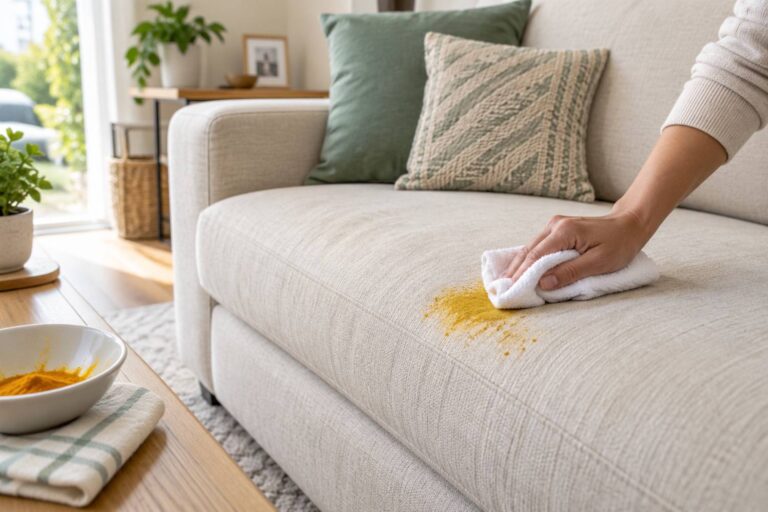
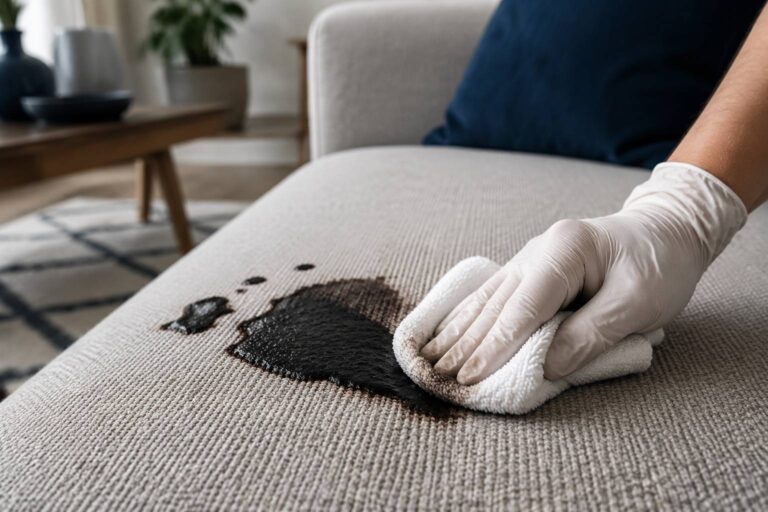
Then press a clean white absorbent cloth or towel against the area to absorb liquid.
Do not wipe from side to side. Wiping can spread the yellow pigment and oil beyond the original spill.
Continue blotting with clean sections of the cloth until little additional moisture transfers.
Dried or Set-In Turmeric
An old turmeric stain needs more patience.
Do not aggressively scrape dried curry from the upholstery, particularly if the fabric is woven, looped or has a raised pile.
Gently remove loose surface material first, then assess the sofa’s fabric and cleaning instructions before introducing moisture or a cleaning product.
Repeatedly soaking an old stain rarely makes it safer to remove.
Check the Sofa Cleaning Code Before Using Any Product
Before trying to remove turmeric stains from a fabric sofa, check the manufacturer’s care label.
Some sofas use cleaning codes such as W, S, W/S or X.
Code | General Meaning | What It Means for DIY Stain Treatment |
W | Water-based cleaning permitted | A controlled water-based treatment may be suitable |
S | Solvent-based cleaning required | Avoid water-based DIY remedies |
W/S or S/W | Water- or solvent-based methods may be permitted | Use only products suitable for the specific fabric |
X | Vacuuming or professional treatment only | Do not use liquid DIY stain removers |
A W code does not mean you can soak the upholstery.
Even water-compatible sofas can develop water rings, shrinkage, dye movement or texture changes if too much moisture is used.
If the label is missing or you cannot identify the upholstery fibre, it is safer to treat the sofa as higher risk.
For a broader explanation of sofa care, see our guide on how to clean a fabric sofa at home without damaging it.
Always Patch-Test for Colourfastness
Removing the turmeric is only half the job. The treatment also needs to leave the sofa’s original colour intact.
Before applying any cleaner to the visible stain, test the exact product and dilution you intend to use on a hidden section of upholstery.
A suitable area may be behind the sofa or underneath a removable cushion.
Apply a very small amount using a white cloth and allow the test area to dry completely.
Do not continue if you notice:
- Sofa dye transferring onto the cloth
- Fading
- Darkening
- A visible drying ring
- Stiffness
- Shrinkage
- Pile distortion
- A change in texture
Do not judge the result while the fabric is still damp. Wet upholstery naturally looks darker.
What You Will Need
For a small turmeric stain on a W- or W/S-coded sofa, you may need:
- Clean white microfibre cloths
- White absorbent towels
- A spoon or blunt edge
- A vacuum cleaner with a clean upholstery attachment
- A small bowl
- Cool or room-temperature water, where permitted
- A fabric-compatible upholstery stain cleaner
- A fan or good natural airflow
Use white cloths rather than coloured towels. This reduces the risk of dye transfer and makes it easier to see whether colour is being removed from the sofa.
How to Remove a Fresh Turmeric or Curry Stain from a Fabric Sofa
The following steps are intended for upholstery that allows controlled water-based cleaning. They are not suitable for every fabric.
Step 1: Remove Solids or Dry Powder
If the spill includes curry, use a spoon to lift solid food away from the fabric.
If you are dealing with dry turmeric powder, vacuum it before applying any liquid.
Take your time at this stage. The less turmeric you push into the sofa, the easier the remaining mark will be to manage.
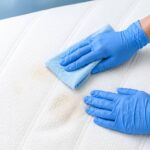
Step 2: Blot the Remaining Liquid and Oil
Press a clean white towel onto a fresh curry spill.
Use a press-and-lift motion rather than rubbing.
Change to a clean section of towel as the liquid transfers.
Work carefully from the outside of the stain towards the centre. This helps prevent the affected area from becoming larger.
Step 3: Apply a Fabric-Compatible Upholstery Cleaner
Once the surface residue has been removed, use an upholstery cleaner that is suitable for your sofa’s care instructions.
Apply a small amount to a clean white cloth rather than spraying the sofa directly.
Direct spraying makes it difficult to control how much product reaches the fabric and may drive liquid deeper into the cushion.
Gently blot the stained area.
Do not saturate it.
A few controlled treatments are generally safer than trying to remove the entire yellow mark with one aggressive application.
Step 4: Work from the Outside Towards the Centre
Continue blotting gradually from the edge of the stain inward.
Do not scrub in circles.
Aggressive friction can spread the turmeric, disturb the weave and change the texture or direction of the fabric pile.
On some upholstery, this physical damage may remain visible even after the stain itself has improved.
Step 5: Remove Cleaning Residue Where the Fabric Allows
If the product instructions and sofa care label permit it, lightly dampen another white cloth with cool or room-temperature water.
Wring it out thoroughly.
The cloth should be barely damp rather than wet.
Blot the treated area carefully to pick up cleaner residue without soaking the upholstery.
Residue left in the fibres can attract soil and may contribute to visible marks after drying.
Step 6: Absorb Moisture and Let the Sofa Dry Naturally
Press a clean dry towel against the area to absorb as much surface moisture as possible.
Then allow the sofa to air-dry.
Use normal ventilation or a fan positioned at a safe distance.
Avoid:
- Sitting on the sofa while it is damp
- Using a hairdryer directly on the stain
- Applying a heater close to the fabric
- Steam-cleaning the spot
- Covering damp upholstery with throws or cushions
Wait until the sofa is completely dry before assessing whether another treatment is needed.
Our guide explaining how long sofas take to dry after cleaning covers the factors that affect upholstery drying in more detail.
What If a Yellow Turmeric Shadow Remains?
It is possible for the greasy part of a curry stain to improve while a pale yellow or orange shadow remains.
Do not immediately respond by applying a stronger chemical.
At this stage, one of two things may be happening:
- Turmeric pigment remains in the fibres.
- Previous cleaning has already altered the sofa’s colour.
These can look surprisingly similar.
If the sofa manufacturer permits a colour-safe oxygen-based upholstery treatment, it may be possible to use one according to the product instructions after a thorough patch test.
However, do not assume that hydrogen peroxide, bleach or another oxidising product is automatically safe because it can lighten turmeric.
If the yellow area becomes paler than the surrounding upholstery, you may no longer be removing a stain — you may be removing the sofa’s dye.
This is particularly important on dark, strongly coloured or patterned sofas.
How to Remove a Dried Turmeric Stain from a Sofa
Dried turmeric usually requires more controlled treatment than a fresh spill.
Start by vacuuming or gently lifting any loose residue.
Next, check the care label and patch-test a suitable upholstery cleaner.
Treat a small area at a time and use minimal moisture.
Allow the sofa to dry fully between attempts so you can accurately judge the result.
Do not keep re-wetting the same stain every few minutes. Repeated saturation can enlarge the affected area and increase the risk of:
- Water rings
- Dye migration
- Detergent residue
- Cushion saturation
- Fibre distortion
If one careful treatment produces little improvement, escalating through stronger and stronger household chemicals is not necessarily the safest next step.
Persistent food stains can instead be assessed through a professional spot and stain removal service in London, particularly where previous DIY products have already been used.
What Should You Not Use on a Coloured Fabric Sofa?
Turmeric stains are frustrating, but some popular DIY solutions can create more damage than the original spill.
Chlorine Bleach
Do not use household chlorine bleach on coloured upholstery.
It may reduce the yellow pigment while also permanently removing the sofa’s dye.
Hydrogen Peroxide as a Default Remedy
Hydrogen peroxide is frequently suggested online for turmeric stains, but it should not be treated as universally safe for sofas.
It can lighten certain dyes and finishes.
Only use an oxidising product if it is specifically appropriate for the upholstery and has passed a proper hidden-area test.
Bicarbonate of Soda Paste
Bicarbonate of soda is another common recommendation, but it is not automatically the safest solution for turmeric.
Turmeric pigments can change appearance in alkaline conditions, while bicarbonate can leave powdery residue inside upholstery.
It should not be the default colour-safe treatment for every fabric sofa.
Ammonia
Avoid experimenting with ammonia on upholstery unless the fabric manufacturer or a suitable professional product specifically allows it.
It can affect dyes, finishes and sensitive fibres.
Acetone or Nail-Polish Remover
Do not use nail-polish remover as a general turmeric stain treatment.
Strong solvents can affect dyes, adhesives, coatings and synthetic fibres.
Strong Alcohol or Unapproved Solvents
An S-coded sofa may require solvent-based cleaning, but that does not mean any household solvent is safe.
The type and application method matter.
Hot Water and Steam
Avoid pouring hot water onto the stain or using a domestic steam appliance as a spot-treatment shortcut.
Heat and excess moisture can affect some dyes and finishes, spread oily contamination and worsen other ingredients present in curry sauces.
Aggressive Brushes
Hard brushing may distort the surface of upholstery and spread the stain.
Use controlled blotting instead.
Mixing Cleaning Chemicals
Never combine different stain removers in an attempt to create a stronger formula.
Mixing chemicals can damage upholstery and, depending on the products involved, may also create hazardous fumes.
Which Sofa Fabrics Need Extra Care?
Some upholstery materials are significantly less forgiving than standard synthetic fabric.
Velvet and Other Pile Fabrics
Velvet can develop shading, pile distortion and visible marks when rubbed or dried unevenly.
Avoid aggressive spot cleaning.
Viscose or Rayon
Viscose-based upholstery can respond poorly to moisture and may develop browning, distortion or texture changes.
DIY wet cleaning can be high risk.
Wool and Silk
Natural fibres often require specialised cleaning chemistry and careful moisture control.
Avoid experimenting with household stain removers.
Linen and Natural Blends
These fabrics may be absorbent and prone to water marks or uneven drying.
Use minimal moisture and always patch-test.
Strongly Coloured or Printed Upholstery
Even if the fibre itself tolerates a product, the dye may not.
Colour transfer during testing is a clear signal to stop.
Similar precautions apply to other strongly pigmented stains. Our guide on removing hair dye from a fabric sofa without fading the colour explains why protecting the upholstery dye can be as important as removing the visible mark.
How to Prevent Water Rings While Removing Turmeric
A turmeric stain can become even more noticeable if cleaning leaves a ring around it.
This usually happens when excess moisture, dissolved soil or cleaning residue travels towards the edge of the damp area before drying.
To reduce the risk:
- Use as little moisture as possible.
- Apply cleaner to the cloth rather than directly to the sofa.
- Work gradually rather than soaking one small patch.
- Use white cloths.
- Remove excess cleaner where permitted.
- Dry the area with good airflow.
- Avoid concentrated heat.
- Do not keep adding water to a partially dried ring.
If a drying outline has already appeared, see our step-by-step guide on how to remove water stains from a fabric sofa without leaving rings.
When Should You Call a Professional Upholstery Cleaner?
Stop DIY treatment if:
- The sofa is marked S or X.
- The care label is missing and the fabric cannot be identified.
- The sofa is made from velvet, viscose, silk or another sensitive material.
- The stain is large or several days old.
- Sofa colour transfers onto your cloth.
- A faded patch appears.
- A water ring develops.
- Several cleaning products have already been used.
- Curry has soaked into the cushion filling.
- The stain becomes larger after treatment.
- One controlled attempt produces no meaningful improvement.
Professional cleaning cannot guarantee that every turmeric stain will disappear completely. The result depends on the upholstery, dye stability, age of the stain, ingredients in the spill and any previous cleaning attempts.
However, professional assessment allows the cleaner to select the treatment based on the specific fibre and stain rather than relying on a universal home remedy.
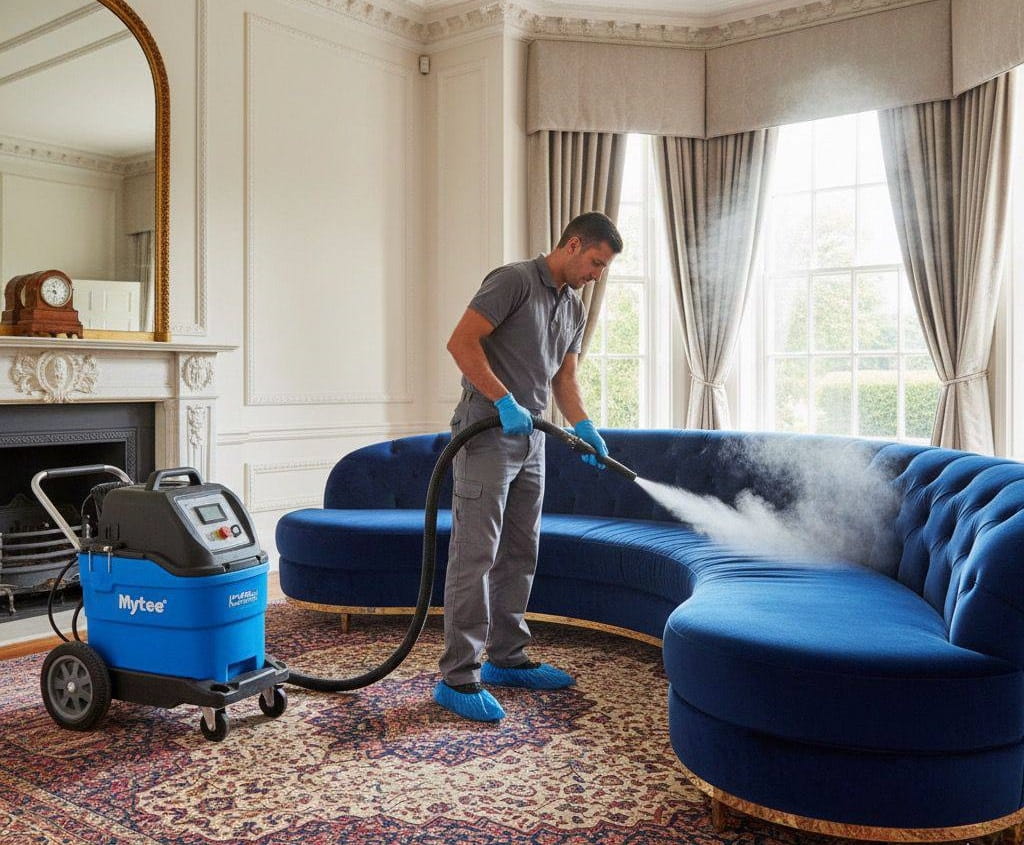
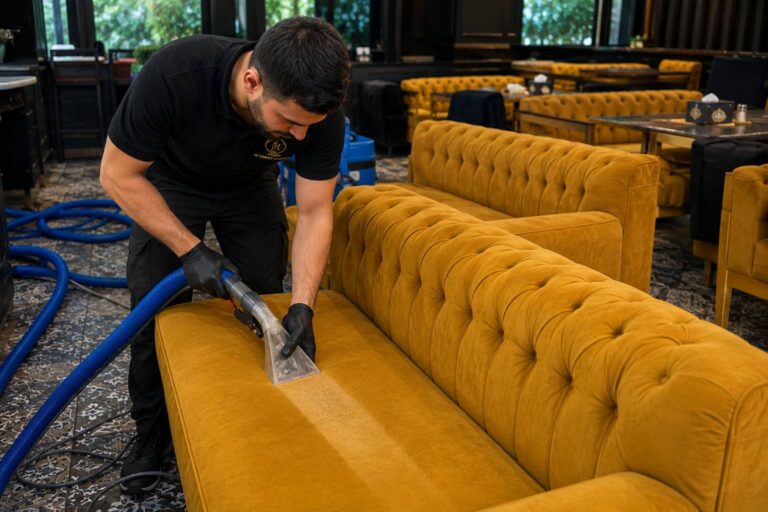
Hi Carpet Cleaner provides professional upholstery cleaning in London for sofas, armchairs and other upholstered furniture, including assessment of staining and previous DIY treatment.
How to Prevent Turmeric Stains on Your Sofa
Prevention is much easier than removing yellow pigment from upholstery.
If you regularly eat curry or turmeric-based food in the living room:
- Use a tray rather than balancing plates directly over the sofa.
- Place a washable throw over pale upholstery during meals.
- Keep open turmeric containers away from soft furnishings.
- Treat spills immediately.
- Avoid rubbing accidental spills with tissues or coloured towels.
- Keep suitable white absorbent cloths nearby.
Responding while the spill is still fresh generally gives you more control than waiting for it to dry.

Frequently Asked Questions
Can turmeric stains come out of a fabric sofa?
They can often be improved, particularly when treated quickly, but complete removal cannot be guaranteed. The result depends on the sofa fabric, dye stability, age of the stain and whether the turmeric was mixed with oil or other ingredients. Always check the care label and patch-test before treating the visible area.
How do you remove dried turmeric stains from a sofa?
Begin by removing loose dried residue without adding water. Check the cleaning code, then patch-test a fabric-compatible upholstery cleaner. Use a small amount, blot rather than scrub and allow the area to dry fully between attempts. Large or persistent dried stains may require professional stain treatment.
How do you get a curry stain out of a fabric sofa?
Lift solid food first and blot liquid or oily residue with a white absorbent cloth. Do not rub. Check the sofa care code before applying any cleaner because curry may contain both turmeric pigment and grease. Use minimal moisture and work from the outside towards the centre.
Can I use bicarbonate of soda on a turmeric stain?
It is not the best universal recommendation. Bicarbonate of soda is alkaline and can change the appearance of turmeric pigment, while powder may remain trapped in upholstery. It can also be unsuitable for certain fabrics. Follow the sofa manufacturer’s guidance rather than automatically applying a bicarbonate paste.
Can hydrogen peroxide remove turmeric from upholstery?
Hydrogen peroxide can affect coloured pigments, but it can also lighten upholstery dye. It should therefore not be treated as a universal sofa-safe turmeric remover. Only use an appropriate colour-safe product where permitted by the manufacturer, and always patch-test first.
Can I use washing-up liquid on a turmeric stain on a sofa?
Not automatically. Although washing-up liquid can break down grease, it may create excessive foam, leave detergent residue or cause a water ring in upholstery. A fabric-compatible upholstery cleaner is usually easier to control. Never use a water-based mixture on a sofa that does not permit water cleaning.
Will sunlight remove turmeric stains from a sofa?
Turmeric pigment can be affected by light, but placing a sofa in strong direct sunlight is not a controlled stain-removal method. Sun exposure can also fade the surrounding upholstery, creating an uneven patch. Avoid trying to bleach the stain naturally with prolonged direct sunlight.
How do I remove turmeric without leaving a water mark?
Use minimal moisture, apply cleaner to a cloth rather than spraying the sofa directly, work evenly and remove excess moisture with a dry white towel. Allow the area to dry naturally with good airflow. Stop if the wet area continues spreading or a distinct drying edge develops.