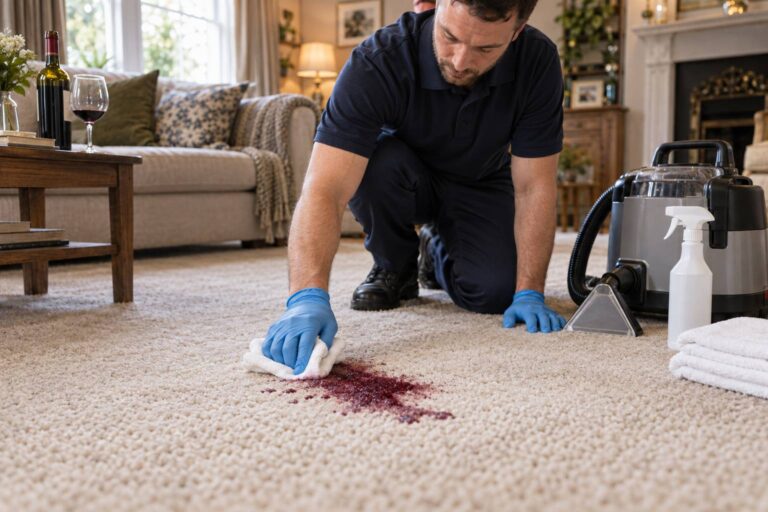
Hot water extraction and steam cleaning are often treated as two names for the same carpet-cleaning method. In everyday UK carpet-cleaning language, the terms are frequently used interchangeably, but technically they are not the same process.
Hot water extraction uses heated liquid water, suitable cleaning solutions and powerful suction to loosen, rinse and physically remove soil from carpet fibres. True steam cleaning, on the other hand, uses hot water vapour and much less liquid, usually without the same rinse-and-recovery process.
For most suitable fitted carpets that require deep cleaning, the most important difference is not simply temperature. It is extraction: the ability to rinse loosened dirt and residues from the carpet and recover the dirty solution into a separate tank.
Key Takeaways
- Hot water extraction and true steam cleaning are technically different, although “steam cleaning” is often used as another name for HWE in the UK.
- Hot water extraction sprays heated liquid into the carpet and then removes it with powerful suction.
- True steam cleaning relies mainly on hot vapour and does not usually provide the same deep rinse-and-recovery action.
- Sticky spills and detergent residues normally require suitable pre-treatment, agitation, rinsing and extraction; heat alone is rarely enough.
- The right cleaning method depends on the carpet fibre, construction, dyes, condition and type of contamination.
Is Hot Water Extraction the Same as Steam Cleaning?
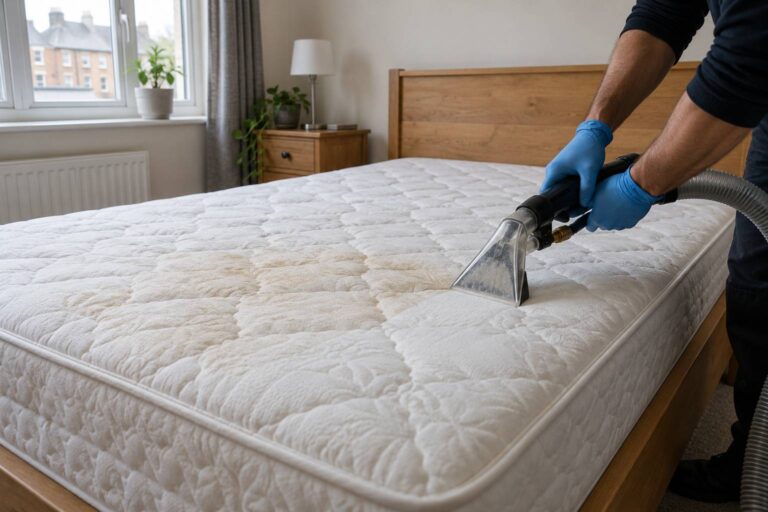
Technically, no. Hot water extraction and steam cleaning are different cleaning processes. Hot water extraction applies heated liquid water and cleaning solution to the carpet before immediately recovering the moisture, loosened soil and cleaning residue with powerful suction.
True steam cleaning converts water into vapour and uses heat with relatively little liquid moisture. It may be useful on suitable hard surfaces and for certain surface-cleaning applications, but it does not rinse a carpet pile in the same way as an extractor.
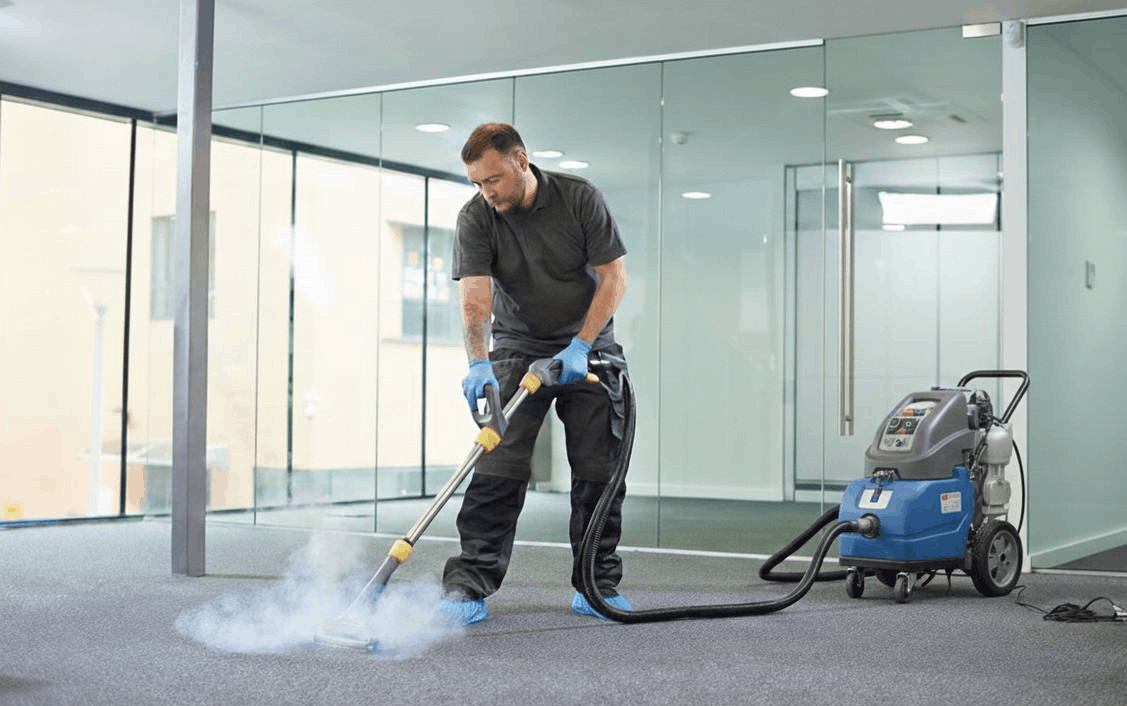
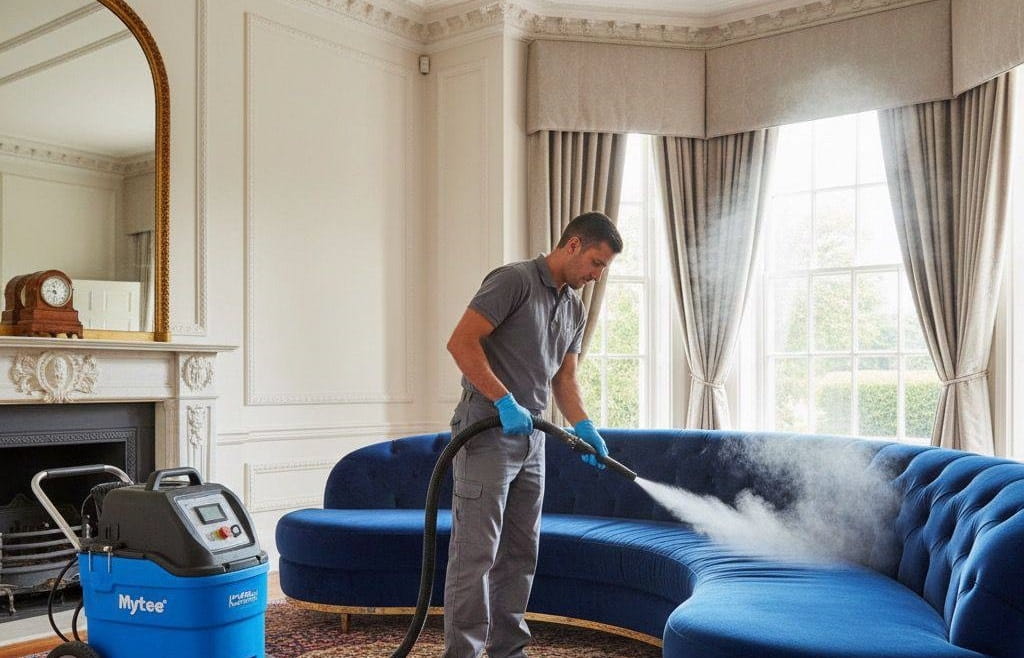
The confusion exists because many UK carpet-cleaning companies describe hot water extraction as “steam cleaning”. A machine can also produce visible vapour when hot solution meets cooler air, even though the carpet is actually being cleaned using hot water extraction.
So when choosing a carpet cleaner, ask how the carpet will be cleaned and whether the dirty solution will be extracted, rather than relying only on the term “steam cleaning”.
Hot Water Extraction vs Steam Cleaning: Quick Comparison
Feature | Hot Water Extraction | True Steam Cleaning |
Water used | Heated liquid water with appropriate cleaning chemistry | High-temperature water vapour |
Main cleaning action | Loosens, rinses and extracts contamination | Primarily uses heat and vapour |
Dirty-water recovery | Yes – solution is recovered into a waste tank | Usually no comparable rinse-and-recovery process |
Equipment | Solution tank, pump, cleaning wand/tool, vacuum system and recovery tank | Boiler or steam generator with steam nozzle/tool |
Deep embedded soil | Designed to remove soil from within suitable carpet pile | Limited ability to flush physical soil from the pile |
Sticky residues | Can rinse away loosened residues after suitable pre-treatment | May loosen some surface residue but cannot extract it in the same way |
Moisture | Carpet remains damp after cleaning | Uses substantially less liquid water |
Best use | Deep cleaning suitable fitted carpets and some upholstery | Suitable hard surfaces and selected surface applications |
Main limitation | Requires drying time and careful moisture control | Limited rinse and soil-recovery capability on carpet |
If you are also comparing extraction with low-moisture methods, our guide to dry carpet cleaning vs steam cleaning explains where each approach may be more appropriate.
What Is Hot Water Extraction Carpet Cleaning?
Hot water extraction, often shortened to HWE, is a professional carpet-cleaning process that combines cleaning chemistry, controlled heat, agitation, rinsing and powerful vacuum recovery. Instead of simply applying hot water to the surface, the process is designed to loosen contamination within the carpet pile and then physically remove it.
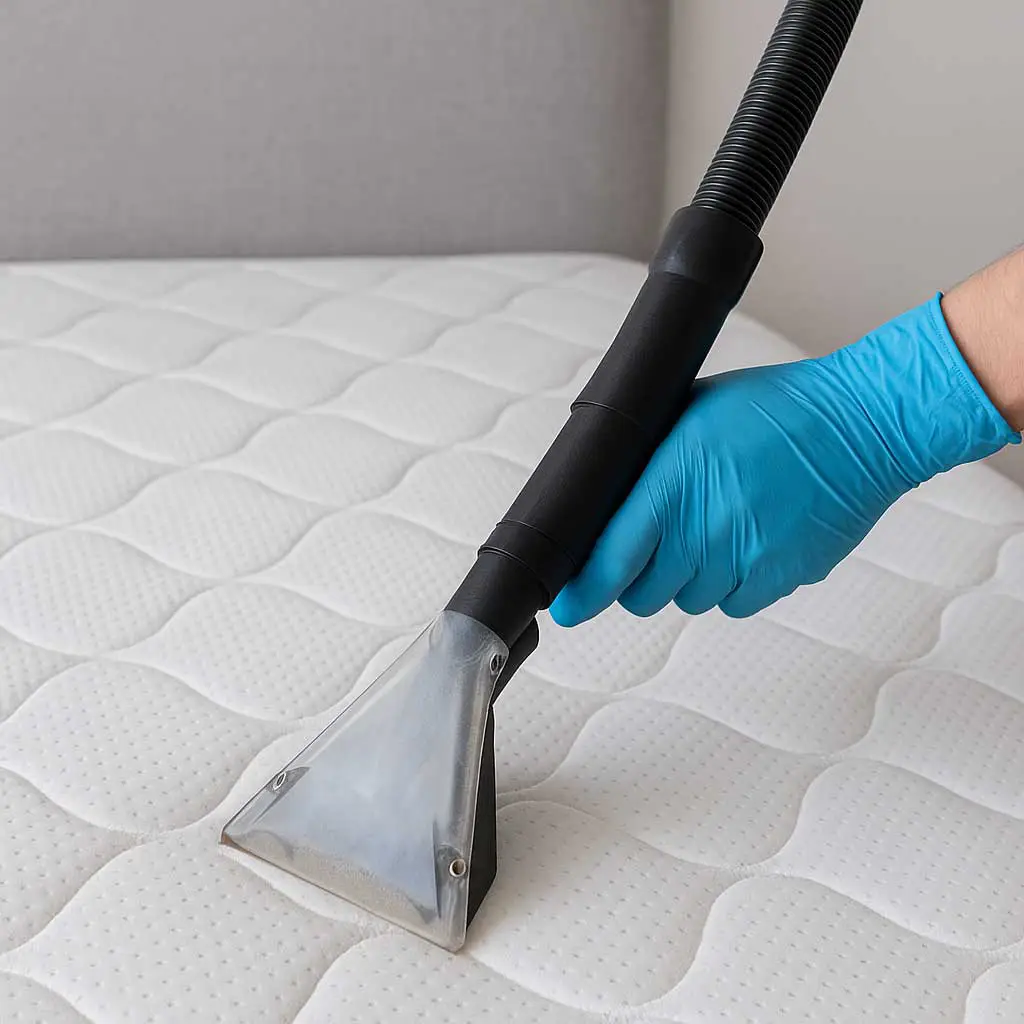
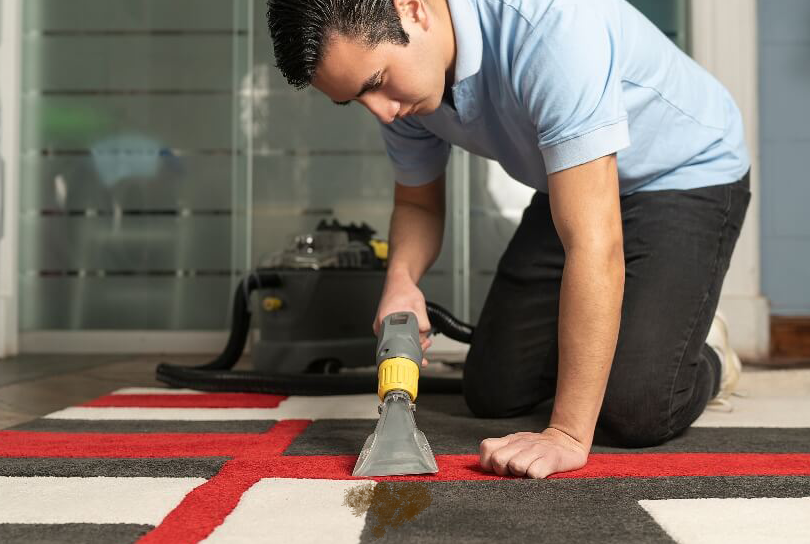
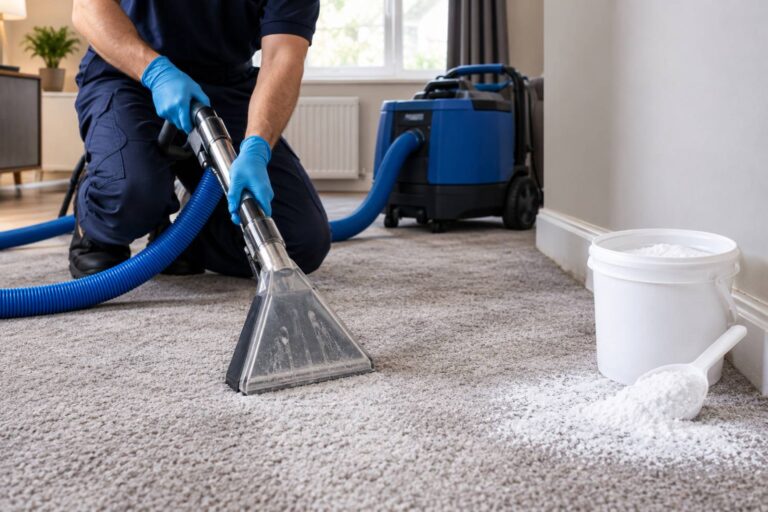
A professional extractor normally contains or connects to a clean-solution system and a separate recovery system. Heated cleaning solution is delivered through a wand or floor tool while powerful suction simultaneously recovers the liquid, suspended soil and cleaning residue into a dirty-water tank. This rinse-and-recovery stage is what distinguishes professional extraction from many surface-cleaning methods.
How Hot Water Extraction Works
1. Carpet inspection and fibre assessment
Before introducing moisture, the technician should identify the carpet fibre, construction, backing, dye stability, existing damage and level of soiling. This helps determine whether hot water extraction is suitable and how much heat, moisture and cleaning chemistry can safely be used.
2. Dry soil removal
Loose grit, hair, dust and other dry particles should be removed before wet cleaning begins. Once dry soil becomes wet, it can become more difficult to extract effectively.
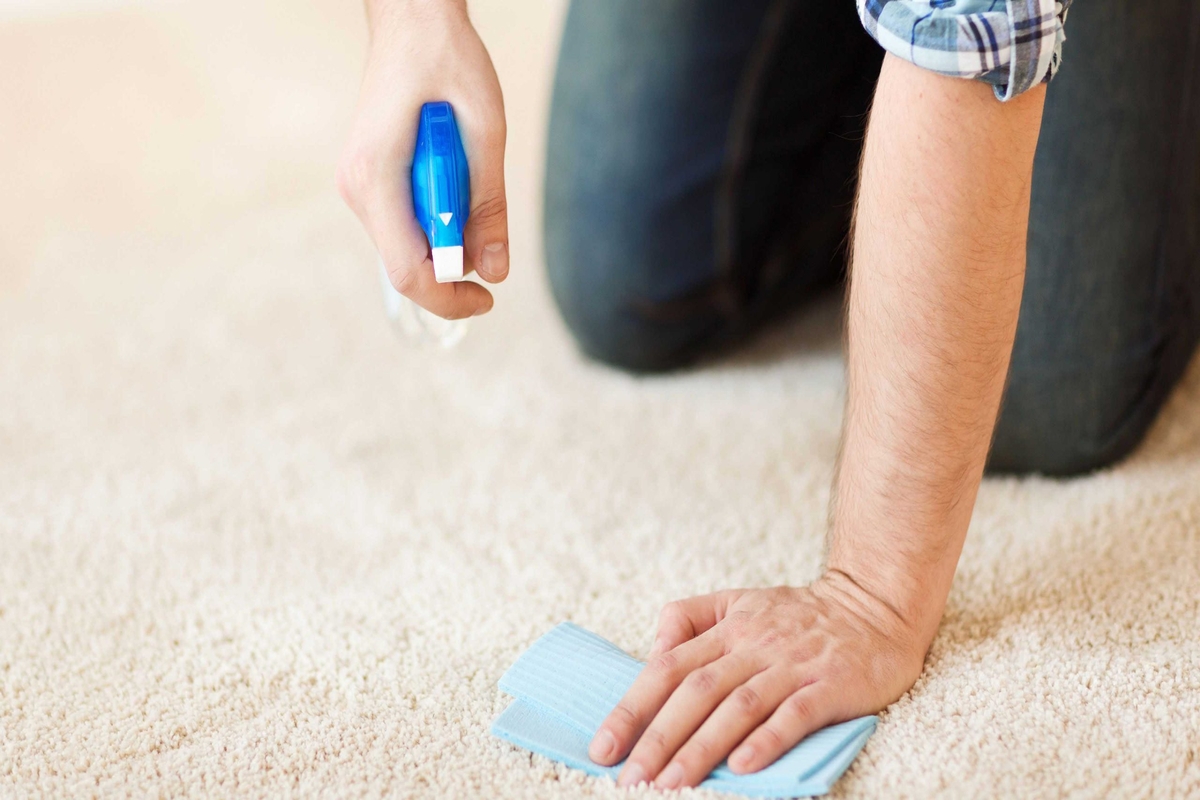
3. Targeted pre-treatment
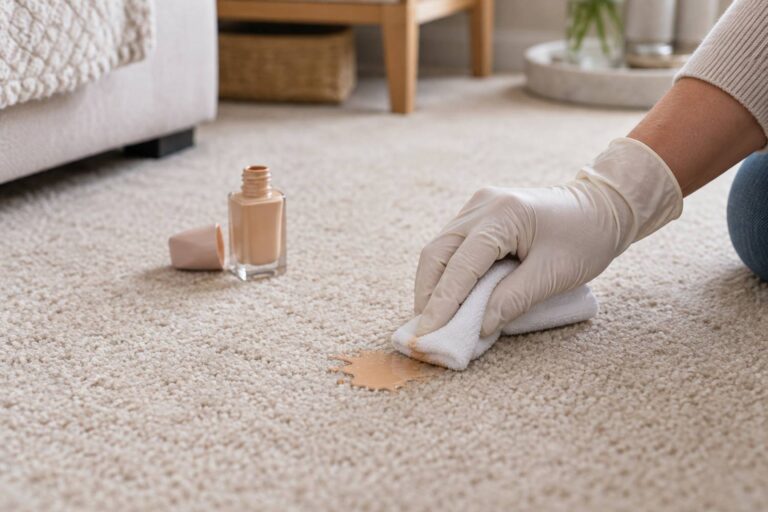
Traffic lanes, greasy areas and individual spills may require different pre-treatment products. A single detergent is not appropriate for every type of contamination.
Persistent localised marks may require a separate professional spot and stain removal treatment rather than simply increasing the temperature or repeatedly cleaning the area.
4. Agitation and dwell time
Where appropriate, the pre-treatment is worked through the carpet pile and given enough time to break down or loosen contamination.
5. Controlled rinse and extraction
Heated solution passes through the cleaning tool while vacuum suction removes the suspended soil and used solution. The technician controls the amount of moisture and can make additional dry extraction passes without introducing more water.
6. Final inspection and drying
After cleaning, remaining problem areas can be reassessed and the pile groomed where appropriate. Ventilation and airflow are then used to help the carpet dry evenly.
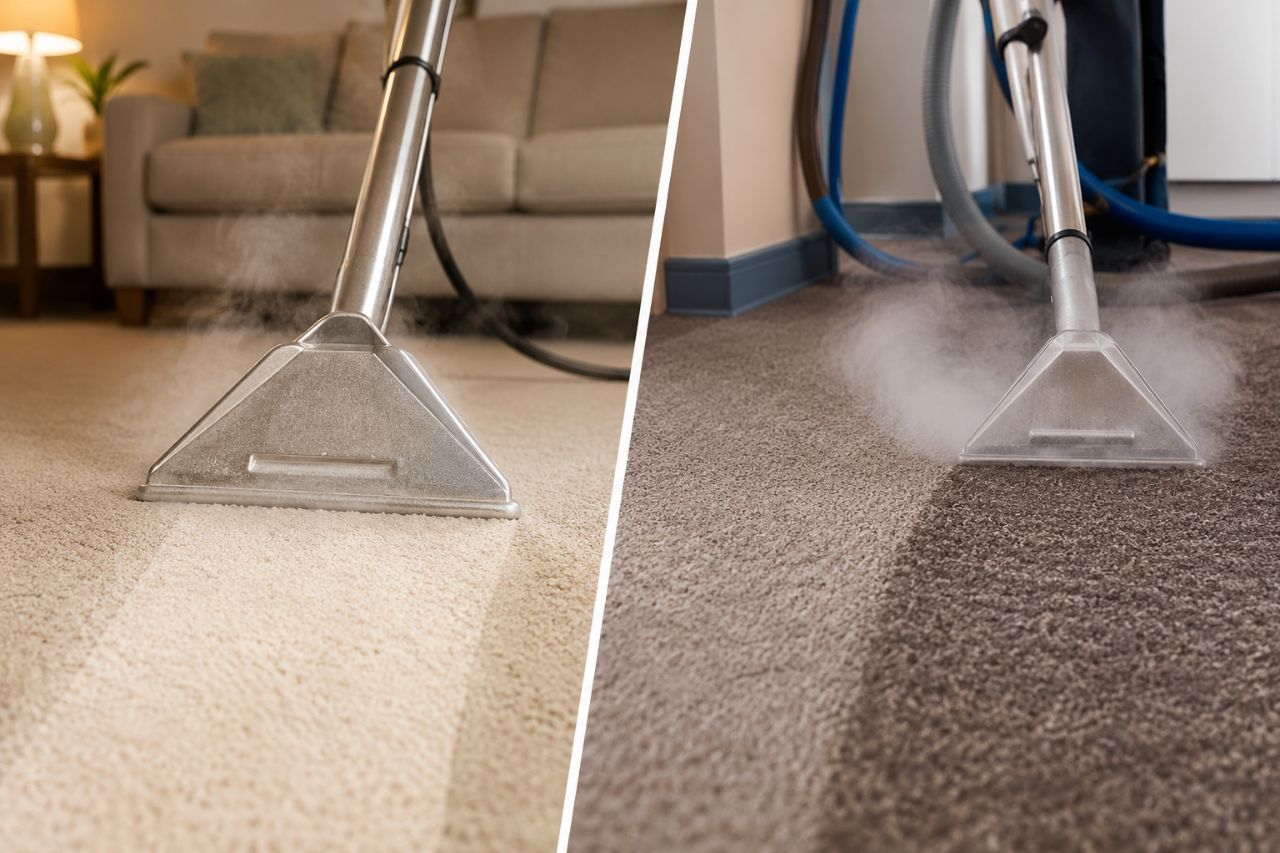
You can also plan access to the room by checking how long professional carpet cleaning takes.
What Is Hot Water Extraction Best For?
On a suitable carpet, hot water extraction is particularly useful when dirt has moved below the surface and ordinary vacuuming or light maintenance cleaning is no longer enough. It is commonly used for fitted carpets in living rooms, hallways, bedrooms, offices and other high-traffic areas. It can also help remove greasy traffic-lane soil, food and drink residue, certain pet-related contamination and cleaning-product residue.
However, hot water extraction should not be treated as a universal solution for every stain or carpet. Some marks are no longer removable contamination. Bleaching, permanent dye change, fibre damage and heat damage cannot simply be extracted from the carpet. Stain-removal results can also be affected by the age of the mark and any DIY chemicals previously applied. This is why professional inspection matters before aggressive stain treatment is attempted.
Why Does Professional Hot Water Extraction Not Leave the Carpet Soaking Wet?
Hot water extraction introduces liquid into the carpet, so the carpet will normally be damp immediately after cleaning. But damp is not the same as saturated. Moisture levels depend on how much solution is applied, how slowly or quickly the cleaning tool is moved, the number of passes made and how efficiently the equipment recovers the water.
Professional extraction equipment is designed to remove a large proportion of the applied moisture during the cleaning process. Additional dry passes can also remove more water without adding further solution.
Carpet thickness, fibre type, indoor temperature, humidity and ventilation can all affect the remaining drying period. Some conditions can extend full drying to 24 hours. For a more detailed breakdown by carpet type and cleaning method, see our guide to how long carpet takes to dry after cleaning.
Domestic and rental machines can work on a similar spray-and-recovery principle, but equipment performance and user technique vary significantly. Applying more water or detergent than the machine can recover can extend drying and leave residue behind. Our comparison of DIY carpet cleaning vs hiring a professional looks at those differences in more detail.
What Is True Steam Cleaning?
True steam cleaning heats water until it becomes vapour. Instead of flushing liquid through a carpet pile and recovering it into a waste tank, a steam machine delivers hot vapour through a nozzle or cleaning attachment. This can make steam useful for suitable hard surfaces, grout and certain other applications where controlled heat and low liquid moisture are required.
However, a true steam cleaner does not normally provide the same process as professional carpet extraction. This distinction is important because seeing vapour around a professional carpet-cleaning wand does not necessarily mean the carpet is being cleaned with steam. Heated extraction solution can produce visible vapour when it meets cooler surrounding air.
The better question is: Is heated liquid being sprayed into the carpet and then extracted into a recovery tank?
If the answer is yes, the process is hot water extraction.
Hot Water Extractor vs Steam Cleaner: What Is Different About the Equipment?
A hot water extractor and a steam cleaner are built to do different jobs. A professional hot water extractor needs to both deliver cleaning solution and recover it. Depending on the system, it may include a clean-water or solution tank, heater, pump, vacuum motors, hoses, carpet wand and a separate recovery tank for contaminated water. The recovery system is particularly important. Soil and cleaning residue must go somewhere after being loosened from the carpet.
A true steam cleaner instead uses a boiler or steam generator to create vapour. The vapour passes through a nozzle or attachment onto the surface being treated. Because considerably less liquid water is introduced, there is normally no equivalent carpet-rinsing process.
That means comparing a hot water extractor vs a steam cleaner based only on temperature misses the main mechanical difference: an extractor is designed to rinse and physically recover contamination from the carpet.
Do Carpet Cleaners Use Steam Technology for Deeper Cleaning and Sticky Messes?
Professional carpet-cleaning equipment can use highly heated water, and visible vapour may sometimes be produced during cleaning. But higher temperature alone does not automatically produce a deeper clean. Sticky contamination usually needs several cleaning stages.
For example, residue from sugary drinks, food, grease or excessive detergent first needs to be identified and loosened with an appropriate treatment. Controlled agitation may then help separate it from the fibres. After that, the loosened contamination needs to be rinsed and removed.
This is where hot water extraction has an important advantage for suitable carpets: instead of simply heating the residue, the process allows the technician to rinse it through the fibres and recover the contaminated solution. True steam may loosen some surface grime, but without sufficient recovery, loosened material can remain within the carpet.
This is also one reason why adding large quantities of shampoo during DIY cleaning can cause problems. If detergent remains behind, the carpet can become sticky and may attract soil more quickly.
If a particular spill remains after general carpet cleaning, targeted spot and stain removal in London may be more appropriate than repeatedly cleaning the entire area.
What Does “Steam Extraction” Mean?
The term steam extraction can be confusing because it does not always describe a specific technical carpet-cleaning process. Some companies use “steam extraction”, “steam carpet cleaning” and “hot water extraction” interchangeably when describing a machine that sprays heated solution and immediately extracts it.
Others may use the term to describe equipment that visibly produces vapour. Rather than relying on the wording alone, ask what happens during the cleaning process.
If heated liquid is sprayed into the carpet and then vacuumed into a dirty-water recovery tank, the process is essentially hot water extraction. If the machine mainly applies water vapour with little or no rinse-and-recovery stage, it is closer to true steam cleaning.
For removable, delicate or specialist pieces, a controlled professional rug cleaning service may be more appropriate.
Hot Water Extraction vs True Steam Cleaning: Key Differences
Depth of Cleaning
Hot water extraction is designed to work through the pile of suitable carpets.
Pre-treatment helps release bonded contamination, agitation can improve contact between the treatment and the soil, and the subsequent rinse moves through the fibres before being recovered.
True steam works differently. It introduces heat and vapour but has much less ability to transport loosened physical soil out of a deep carpet pile.
For heavily trafficked fitted carpet, therefore, recovery power can be more important than simply using a hotter machine.
Stains and Sticky Residues
Neither method should be described as capable of removing every stain.
A professional cleaner must first determine what caused the mark. Protein-based contamination, tannins, grease, dyes, cosmetics and detergent residues can all require different treatment.
With hot water extraction, suitable pre-treatment can be followed by controlled rinsing to remove loosened contamination.
Some marks may need dedicated stain-removal chemistry before or after the main clean, while permanent colour loss or fibre damage cannot be removed by cleaning.
Moisture and Drying Time
True steam uses significantly less liquid water, so a treated surface may become usable relatively quickly.
Hot water extraction deliberately uses liquid to rinse the carpet and therefore requires a drying period afterwards.
Efficient professional extraction should leave the carpet damp rather than excessively wet. Drying speed then depends on factors such as carpet density, fibre, room temperature, humidity and airflow.
Carpet Suitability
Hot water extraction can be suitable for many synthetic and wool carpets when cleaning chemistry, temperature and moisture are properly controlled.
It is not automatically suitable for every textile.
Certain delicate fibres, unstable dyes, specialist backings and handmade or antique pieces can require lower-moisture or specialist cleaning methods.
For that reason, the cleaning process should be selected after inspecting the material rather than simply applying the same method to every carpet or rug.
Which Method Should You Choose for Carpet?
For a suitable fitted carpet affected by embedded soil, traffic-lane contamination or removable sticky residue, professional hot water extraction will often provide the more complete cleaning process because it combines treatment, rinsing and physical recovery.
True vapour steam is better viewed as a different cleaning technology rather than a stronger version of hot water extraction.
For moisture-sensitive or specialist textiles, the most suitable option may be neither standard HWE nor steam. Fibre type, dyes, construction and condition should determine the method.
If you are not sure what your carpet requires, a professional assessment through our carpet cleaning service in London can determine whether hot water extraction, a lower-moisture process or another cleaning approach is appropriate.
How HiCC Uses Hot Water Extraction in London
At HiCC, carpet cleaning begins with an assessment rather than a fixed cleaning formula. The technician considers the carpet fibre, construction, condition, staining and level of soiling before deciding how much moisture, heat, cleaning solution and agitation should be used.
Where hot water extraction is suitable, the process can include dry soil removal, targeted pre-treatment, controlled agitation, heated rinsing and powerful extraction. Additional treatment is used only where the carpet and type of contamination require it. The method may also be adjusted or replaced where moisture or temperature would create unnecessary risk.
If you are comparing services before booking, our guide to carpet cleaning prices in London explains the main factors that affect the cost of professional cleaning.

Before the appointment, follow our checklist on how to prepare your home for carpet cleaning.
Frequently asked questions
Is hot water extraction the same as steam cleaning?
No, not technically. Hot water extraction sprays heated liquid and suitable cleaning solution into the carpet and then uses powerful suction to remove the moisture and loosened contamination. True steam cleaning primarily uses hot water vapour. However, in everyday UK carpet-cleaning terminology, hot water extraction is often marketed as “steam cleaning”.
What is hot water extraction carpet cleaning?
Hot water extraction is a carpet-cleaning process that combines suitable cleaning chemistry, controlled heated water and powerful vacuum recovery. Soil is loosened within the carpet pile, rinsed and then physically extracted into the machine’s recovery tank.
What is the difference between a hot water extractor and a steam cleaner?
A hot water extractor is designed to apply cleaning solution and recover the dirty liquid through suction. A steam cleaner converts water into vapour and applies the vapour to a surface. The main difference is therefore not simply temperature: an extractor has a dedicated rinse-and-recovery process.
What does steam extraction mean?
“Steam extraction” is often used loosely rather than as a precise technical term. If the machine sprays heated liquid into the carpet and recovers it into a waste tank, the process is effectively hot water extraction. If it mainly applies vapour without comparable recovery, it is closer to true steam cleaning.
Does hot water extraction remove sticky spills and detergent residue?
It can remove many sticky residues when the correct treatment is used first and the contamination is thoroughly rinsed and extracted. Results depend on the substance, carpet fibre, age of the spill and any chemicals previously applied. Permanent dye or fibre damage cannot be cleaned away.
Can hot water extraction damage a carpet?
It can cause problems when used on an unsuitable carpet or when moisture, heat or cleaning chemistry are poorly controlled. This is why fibre identification, inspection and testing should take place before cleaning rather than assuming that HWE is suitable for every carpet.
How long does carpet take to dry after hot water extraction?
Most correctly extracted carpets should be left damp rather than soaked. Drying time varies according to fibre type, pile density, room temperature, humidity, ventilation and the amount of moisture recovered during cleaning. Under less favourable conditions, complete drying can take up to 24 hours.
Is hot water extraction suitable for wool carpet?
Hot water extraction can be suitable for many wool carpets when wool-safe chemistry, controlled moisture and temperature, and effective extraction are used. However, the construction, dyes and overall condition need to be assessed first. Some wool rugs and specialist textiles require a different controlled cleaning method.